
2026 MID TERM ElectionS Measures Across the State of California
IMPORTANT NOTES FOR ALL VOTERS:
- There are 14 statewide propositions and 397 local measures on the ballot in California. Our mission is to provide the information voters need and make voting easier so we can have the highest level of participation by Iranian American voters.
- Please REVIEW the general statements provided below that can guide you in your decisions.
- NOVEMBER 3, 2026 is the LAST DAY to return mail-in-ballots IN A DESIGNATED BALLOT BOX OR vote in-person AT A COUNTY VOTING LOCATION.
- VOTE EARLY TO EXPEDITE THE PROCESS – Do NOT USE the US MAIL BOXES to send back your ballots because the changes to the postal service processing delays delivery and Trump administration may attempt to interfere with the voting process.
- Be sure to SIGN AND DATE the back of your envelope.
- If you would like to look at your entire ballot and get additional information about candidates we have endorsed or on measures (including endorsement from trusted, forward-looking organizations), we suggest you visit: https://bluevoterguide.org/
EXPLANATION ABOUT 14 CA PROPOSITIONS IN PERSIAN IS AVAILABLE HERE
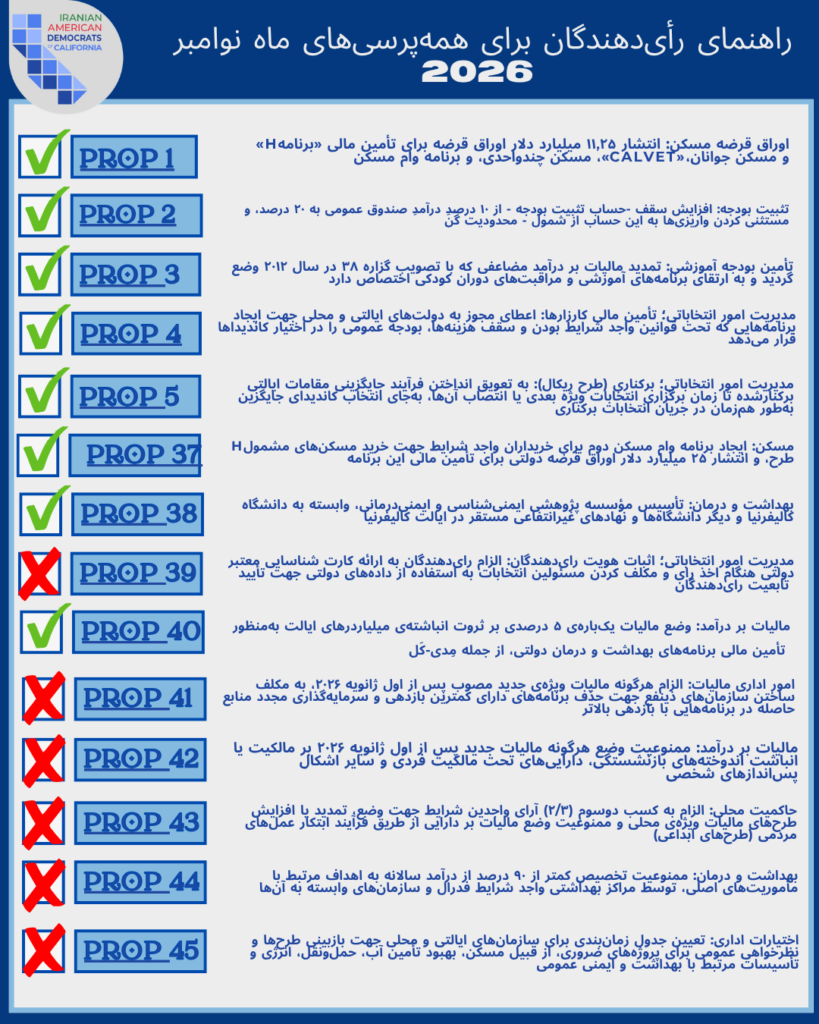
توضیحات مربوط به ۱۴ طرح پیشنهادی (Proposition) ایالت کالیفرنیا به زبان فارسی در اینجا موجود است.
HIGH LEVEL EXPLANATION FOR MEASURES IN LA AND ORANGE COUNTY IN PERSIAN IS AVAILABLE HERE
توضیحات کلی درباره طرحهای پیشنهادی (Measures) حوزه لسآنجلس و اورنج به زبان فارسی، در اینجا قابل دسترسی است.
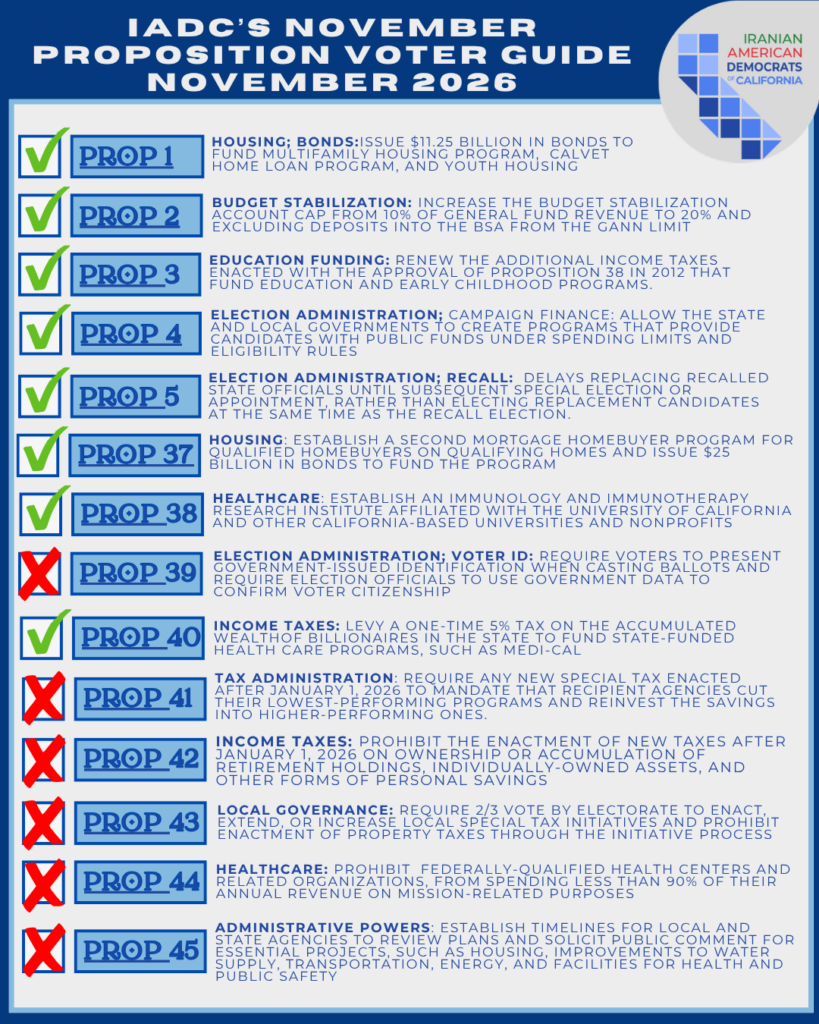
2026 California Statewide Propositions — Quick Guide
The propositions with single digit numbers were placed on the ballot by the state legislature. Those with 2-digit numbers were placed on the ballot by petition drives.
Prop 1 — YES: Housing Bonds
$11.25 billion in bonds for housing programs, mostly for lower-income residents, plus veteran home loans and mental health services. No direct tax increase; repaid from the general fund.
Prop 2 — YES: Rainy Day Fund
Increases deposits into California’s budget stabilization (“rainy day”) fund during high-revenue years. Helps smooth out state budget swings and reduce program cuts in lean years.
Prop 3 — YES: Millionaire Tax Extension
Makes the existing higher tax rate on top earners (set in 2012) permanent instead of letting it expire in 2031, and indexes it to inflation. Not a new tax — just an extension.
Prop 4 — YES: Public Election Funding
California is the only state in the nation that has had a ban on matching of public funding raised. This will remove that ban. Allows state and local governments to create public campaign financing programs (currently limited to a few charter cities). Doesn’t create a program itself, just permits one in the future.
Prop 5 — YES: Recall Process Reform
Separates the replacement election from the recall election. If an official is recalled, the next-in-line (e.g., Lt. Governor for Governor) takes over, rather than a simultaneous replacement vote.
Prop 37 — YES: Down Payment Help for Homebuyers
Creates a state second-mortgage program helping moderate-income buyers with down payments on new homes. Funded by $25 billion in bonds, repaid through loan repayments, not taxes.
Prop 38 — YES: Immunology Research Funding
$8.4 billion in bonds for immunology and immune therapy research, including cancer, Alzheimer’s, and heart disease. Bipartisan support, timed to offset federal research funding cuts.
Prop 39 — NO: Voter ID Requirement
Would require government-issued ID to vote in person and partial ID numbers for mail ballots. Opponents say it echoes federal “SAVE Act” tactics and could disenfranchise millions lacking easy access to passport or birth certificate.
Prop 40 — YES: Billionaire Tax
One-time 5% tax on net worth over $1 billion (~250 Californians who reside here in 2026), payable over 5 years funding healthcare and education to offset federal cuts. Backed by major labor unions; opponents call it a start-up/wealth-flight risk. Direct action taken to address the funding lost due to Trump’s HR1.
Props 41 & 42 — NO (both): Nullify the Billionaire Tax
A billionaire-backed pair designed to gut Prop 40 even if it passes — 41 forces new tax revenue to count against the state spending cap; 42 permanently bans any future wealth tax. Vote No on both if you support Prop 40.
Prop 43 — NO: Raise the Bar for Local Taxes
Requires citizen-initiated local special taxes to meet a two-thirds vote instead of a simple majority. Critics say it lets a 33% minority block what most residents want, making it harder to fund local services.
Prop 44 — NO: New Rule for Health Clinics
Requires nonprofit health centers to spend 90% of revenue on direct patient care (up from 85%). Opposed by both parties and healthcare providers, who warn it could force layoffs and clinic closures. The real problem of overpaid CEOs will not be addressed.
Prop 45 — NO: Fast-Track Environmental Review
Shortens and simplifies CEQA environmental review timelines. Backed by developers, opposed by environmentalists who say it cuts public comment and rushes projects through.
>
> continue below to see the list of all measures organized according to county and city <<
WHAT TO WATCH OUT FOR ON THE BALLOTS FOR november midterms?We reviewed 397 measures for the November 2026 general election. There are 3 reasons contributing to unusually higher number of measures across the state:
We have issued the following voter guide for 167 out of 201 measures which are not related to Public Safety or School Funding. For 37 ballot measures (9%), we have issued no opinion because of the complex nature of the measure or inadequate data available. 21 of the 37 have no stated position by their respective central committees, hence we urge voters to refer to local watchdog organizations for guidance. There are 81 Public Safety measures – 34: YES, 47: Refer to our General Statement There are 111 School Funding measures – Refer to our General Statement |
|||||||||||
| SCHOOL BONDS & SALES TAX MEASURES | This November, 106 school bond measures across 35 California counties seek voter approval to update the state’s aging school infrastructure. IADC strongly supports these measures as a general matter, this need is real and long overdue, and it is more urgent now that the Trump administration has withheld $800 million in California education funding and canceled $148 million in teacher training grants since January 2025, with IDEA oversight disruptions threatening the state’s 851,000 students with disabilities and districts facing cuts to funding for homeless students, English learners, and mental health and tutoring support. In this environment, local bonds have become one of the few fiscal tools districts still fully control.
That reliability isn’t cost-free, and the cost isn’t evenly shared: bonds are repaid through property taxes, and in counties like Alameda and San Mateo, where bond measures often share a ballot with regressive sales tax increases, voters are asked to absorb both at once, a burden felt most acutely in lower-income communities like Compton. IADC urges voters to support genuine infrastructure investment, but to evaluate each district’s facilities plan individually, checking for independent oversight committees, mandatory audits, and whether the stated need reflects real deferred capital investment rather than operational costs reclassified to qualify for bond financing, while weighing the cumulative tax burden when multiple measures share the same ballot. |
||||||||||
| PUBLIC SAFETY SERVICES MEASURES | IADC believes funding fire protection, wildfire prevention, and emergency medical response is essential, and generally supports local measures dedicated to these services — including the fire, EMS, and public safety measures reviewed across Williams, El Dorado County, Pasadena, Napa County, Rocklin, American Canyon, St. Helena, Carpinteria, Mt. Shasta, and Weed. At the same time, we recognize why these measures often face voter skepticism: sales taxes are regressive and hit low- and middle-income families hardest amid rising costs; without strict “maintenance of effort” language, new taxes can simply free up existing funds for other priorities rather than adding net public safety dollars; crowded ballots create voter fatigue; California’s two-thirds threshold means even popular measures often fail; and countywide taxes don’t always guarantee that locally generated revenue benefits the community that raised it.
Because of this tension, IADC’s position is a balancing act rather than a blanket rule: we generally lean YES on 11 out of 29 measures dedicated to public safety and emergency services, but we urge voters to weigh their own district’s specifics: oversight and audit requirements, sunset clauses, legal restrictions on fund use, and the taxing body’s track record, before voting. Where a measure lacks meaningful accountability safeguards, IADC takes a NEUTRAL position and leaves that judgment to the voters closest to the issue. |
||||||||||
| SALES TAX MEASURES | This November, voters across 8 California counties will find 17 local sales tax measures on their ballots, funding everything from general city services to street infrastructure to public safety. These measures share a common driver: deep federal cuts to healthcare, social services, and transit funding have left cities and counties with real budget shortfalls they cannot legally deficit-spend their way out of, making local sales tax revenue one of the few tools left to maintain services. IADC generally supports renewal measures that sustain existing services without raising rates, and takes a more cautious, case-by-case view of new taxes and rate increases, which carry a heavier burden for low- and middle-income households already facing rising costs.
Voters should also understand a key legal constraint that applies to every one of these measures: California law caps the effective combined sales tax rate at 10.25% for most jurisdictions (with a statewide floor of 7.25%, and select cities reaching as high as 11.25%). Many communities on this year’s ballot are already at or near that ceiling, meaning a “yes” vote does not guarantee the revenue will ever be collected — a measure that pushes a jurisdiction over the cap requires separate authorizing legislation from the state Legislature before it can take effect. IADC urges voters to check whether their jurisdiction is near the cap, confirm whether a measure’s accountability provisions are legally binding or merely advisory, and weigh these factors alongside the underlying merit of the services being funded before casting their vote. |
||||||||||
| CITY GOVERNANCE – TERM LIMITS, DISTRICT ELECTIONS, APPOINTED vs> ELECTED OFFICES | On term limits and electoral structure, IADC generally favors reasonable limits, typically in the range of 12 to 16 total years, that balance accountability with the experience needed for effective governance; we support measures like South El Monte’s Measure CL and Whittier’s Measure EL that cap service around this range, while opposing measures we see as either too permissive, like Rosemead’s proposal allowing five consecutive four-year terms, or too restrictive, like Hacienda La Puente USD’s two-term cap on school board members. On electoral structure, IADC supports reforms that expand representation and participation, including district-based elections over at-large systems (Burbank’s Measures CC and CD) where they give geographically concentrated communities a fairer shot at representation, ranked-choice voting (Irvine’s Measure D), and expanding the franchise to 16- and 17-year-olds in local elections (Culver City’s Measure YV).
On the question of appointed versus elected offices, IADC’s consistent position is that City Clerk and City Treasurer, roles responsible for overseeing elections and public finances, should remain directly elected rather than appointed, because independence from the city council reduces the risk of collusion and keeps these offices directly accountable to residents; this guides our opposition to conversion measures in Amador, Merced, Galt, Solano, and Tehama counties. We treat other administrative roles differently: we support appointment structures that reflect statewide best practice and bring cities in line with common governance norms, such as Folsom’s move to appoint a city attorney (already standard in roughly 97% of California cities) and clearer delegation of authority to boards and commissions. In all cases, IADC urges voters to look past the “appointed vs. elected” label alone and consider which structure best preserves independent accountability for the specific office in question. |
||||||||||
continue below to see the list of all measures organized according to county and city |
|||||||||||
| HOTEL TAX / TRANSIENT OCCUPANCY TAX MEASURES | This November, voters across at least 15 California counties will consider 24 hotel tax measures, nearly all funding public safety, emergency response, infrastructure, and general city services. IADC supports these measures across the board. Unlike sales taxes, which fall on residents purchasing everyday goods, transient occupancy taxes are paid almost entirely by visitors staying in hotels, motels, and short-term rentals, making them one of the few local revenue tools that fund essential services without directly burdening residents’ cost of living, particularly for lower- and middle-income households already facing rising expenses.
Given this favorable structure, IADC recommends a YES vote on hotel tax measures in this cycle, including increases in Burbank, Culver City, Hawthorne, Lynwood, Monterey Park, Rancho Palos Verdes, Los Alamitos, Orange, Placentia, Westminster, and counties including Fresno, Madera, Monterey, Solano, and Yolo, among others. That said, voters should still confirm that a measure includes accountability provisions, such as citizen oversight and mandatory audits, as seen in Placentia’s and Westminster’s measures, and should note that some increases are substantial (for example, Hawthorne’s jump from 12% to 17% and Solano County’s from 5% to 12%), meaning the cumulative rate and its competitiveness with neighboring jurisdictions is worth a second look even where IADC’s general guidance is supportive. |
||||||||||
| 2026 UTILITY USER TAX (UUT) MEASURES | California’s utility user taxes vary widely by city, generally ranging from 1% to 11%, with about 5% being the most common rate and roughly 150–160 cities statewide levying one; under Proposition 218, voters must directly approve any UUT and how it’s spent. IADC’s position varies by measure based on this variation: we support San Marino’s Measure U, a straightforward extension of an existing 6% rate that funds police, fire, paramedic, and infrastructure services with no rate increase. We take a neutral stance on South Gate’s Measure SG (a new 8% tax, above the statewide average, for streets, parks, and public safety) and Marina’s Measure Q, where the 7% rate would be the highest utility tax on the Monterey Peninsula, has no sunset clause, and because it is structured as a general tax rather than a dedicated one, carries no legal guarantee that revenue is spent on the public safety services it’s marketed around, even though it only requires a simple majority rather than the two-thirds threshold a dedicated tax would need.
Voters should note the distinction between these local UUTs and the separate statewide flat fixed charge on electric bills (from Assembly Bill 205), which funds grid infrastructure for investor-owned utilities and is unrelated to any measure on this ballot. As with other tax measures, IADC urges voters to check whether a UUT is a general tax (usable for any city purpose, passing with a simple majority) or a dedicated tax (legally restricted to a stated purpose, requiring a two-thirds vote), and to weigh that distinction against the rate being proposed and whether the city’s existing rate is already high relative to its region. |
||||||||||
| 2026 CA TRANSPORTATION MEASURES | This November, voters across California will consider 34 transportation-related measures, ranging from a landmark regional transit sales tax (Bay Area Proposition RTM) to dozens of small, dedicated road-maintenance parcel taxes in El Dorado County. IADC’s position follows a consistent framework: we generally support YES on measures with a direct, legally restricted link between the tax paid and the transportation benefit received, i.e. dedicated parcel and special taxes (El Dorado’s road zones, Marin’s Measure FF, Trinity’s Measure D, Alameda’s Measures P and T), renewals of already-proven tools rather than new levies (Riverside’s Measure A, Union City’s Measure II), and Proposition RTM, given the scale of the transit fiscal cliff it addresses and its broad institutional support. We also support San Francisco’s Proposition H, a dedicated 15-year property tax for the SFMTA.
Where a measure is a new, broad general sales tax that bundles transportation with unrelated city services and lacks binding accountability provisions, IADC takes a NEUTRAL position. This includes Fresno’s Measure S, Placer’s Measure I, Yolo’s Measure Y, Humboldt’s Measure D (Fortuna), Monterey’s Measure T, and San Bernardino’s Measure I, where the Central Committee actively opposes extension. We recommend NO on measures that aren’t genuine funding mechanisms or that raise structural concerns, including San Francisco’s Proposition G (which reopens a road to vehicle traffic rather than funding anything) and Needles’ Measure L (a property tax the Central Committee opposed). As with other tax categories, IADC urges voters to distinguish general taxes (simple majority, fund diversion risk) from dedicated special taxes (higher threshold, legally locked purpose), and to weigh whether a measure’s expenditure mix and oversight provisions match its stated purpose before voting. |
||||||||||
| BELOW ARE THE COMPLETE LIST OF 397 LOCAL MEASURES FROM ACROSS CALIFORNIA FOR NOVEMBER 2026 | |||||||||||
| County | City | Measure’s Name | Domain | Category | Suggested By IADC | IADC’s Rationale |
| Alameda County | Alameda | Measure L: GO Bond Measure | CITY | PUBLIC SAFETY | YES | City of Alameda issuing 300,000,000 in bonds to prepare for emergencies, earthquakes, and sea-level rise, prevent flooded tides, repair. IADC supports this measure, consistent with its view that funding fire protection, wildfire prevention, and emergency medical response is essential, while urging voters to check for sunset clauses, audit requirements, and legally binding use restrictions specific to this district. |
| Alameda County | Alameda | Measure M: Charter Amendment Amend and Repeal Outdated Provisions | CITY | GOVERNANCE | NEUTRAL | Revisions to charter amendment. Ballot question not yet available A governance or structural change whose practical effect is more administrative than ideological. |
| Alameda County | Alameda | Measure N: Charter Amendment Leases and Sales of Real Property Measure | CITY | CHARTER | NEUTRAL | Amend City charter to change sales or leases of city real property exceeding 1 year to be approved by resolution rather than by ordinance and to reduce the city council approval threshold from supermajority to simple. A largely administrative or structural charter change with no clear ideological content. |
| Alameda County | Albany | Measure O: Requirement to Zoning Changes Measure | CITY | ZONING | YES | Amending the residential voter requirements for zoning changes to the R-1 zoned areas of the City without majority neighborhood voter approval Changes how much say neighbors have over zoning changes in single family areas; this could ease housing approvals or could weaken community input, depending on which direction the text actually moves. Removes a neighborhood-vote barrier to R-1 zoning changes — consistent with pro-housing stance. |
| Alameda County | Albany | Measure P: Street Paving and Storm Drain Parcel Tax Measure | CITY | TRANSPORTATION | YES | Updating the Street Paving and Storm Drain Special Tax – Add low-income rebates and low-income tax exemptions and rebates. IADC supports this measure as a dedicated transportation funding tool with a direct, legally restricted link between the tax paid and the benefit received. |
| Alameda County | Albany | Measure Q: EMS, ALS, Fire Protection Parcel Tax Measure | CITY | PUBLIC SAFETY | YES | Updating the Emergency Medical Services, Advanced Life Support, and Fire Protection Specifically tax on Residential and commercial property. IADC supports this measure, consistent with its view that funding fire protection, wildfire prevention, and emergency medical response is essential, while urging voters to check for sunset clauses, audit requirements, and legally binding use restrictions specific to this district. |
| Alameda County | Albany | Measure R: Business License Tax Measure | CITY | PUBLIC SAFETY | YES | Increase City’s Business license tax to support general services such as fire protection, public Safety, environmental and community. IADC supports this measure, consistent with its view that funding fire protection, wildfire prevention, and emergency medical response is essential, while urging voters to check for sunset clauses, audit requirements, and legally binding use restrictions specific to this district. |
| Alameda County | Albany | Measure S: Real Property Transfer Tax Measure | CITY | PUBLIC SAFETY / RECREATION | YES | Adjust Real Property Transfer Tax from $15 to between $10-30 per $1,000 purchase, depending on property purchase price for street and park. IADC supports this measure, consistent with its view that funding fire protection, wildfire prevention, and emergency medical response is essential, while urging voters to check for sunset clauses, audit requirements, and legally binding use restrictions specific to this district. |
| Alameda County | Albany | Measure T: Street Trees & Street lighting Parcel Tax Measure | CITY | TRANSPORTATION | YES | Special parcel tax on non-exempt property in the City at $0.0354 per lot square foot to maintain and improve public street trees. IADC supports this measure as a dedicated transportation funding tool with a direct, legally restricted link between the tax paid and the benefit received. |
| Alameda County | Berkeley | Measure AA: Initiative Soda Tax Measure | CITY | HEALTHCARE FACILITY PROJECT | YES | Replacing the City’s $0.01 per fluid ounce general tax on the distribution of sugar-sweetened beverages with a $0.02 per fluid to fund public health, nutrition, and drinking water accessibility programs by nonprofits. Funds hospital or public health facility capital needs, protecting local access to emergency and medical care. |
| Alameda County | Berkeley | Measure U: Bond Measure | CITY | PUBLIC SAFETY / RECREATION / INFRASTRUCTURE | YES | $300,000,000 in general obligation bonds to fund acquisition and improvement of fire stations, emergency response facilities, and parks. IADC supports this measure, consistent with its view that funding fire protection, wildfire prevention, and emergency medical response is essential, while urging voters to check for sunset clauses, audit requirements, and legally binding use restrictions specific to this district. |
| Alameda County | Berkeley | Measure V: Sales Tax Measure | CITY | PUBLIC SAFETY / RECREATION | GENERAL STATEMENT ON PUBLIC SAFETY SERVICES | Levying 0.5% sales tax in Berkeley, increasing total sales tax rate to 10,75%; general tax for general fund for uses. IADC takes a neutral position here: while it generally supports funding for fire, EMS, and public safety services, this measure’s tax structure, accountability safeguards, or district track record warrant closer voter scrutiny before a clear recommendation. |
| Alameda County | Berkeley | Measure W: Charter Amendment Measure | CITY | GOVERNANCE – ELECTION | YES | Amending the City Charter to reduce candidate filing fees, clarify and revise initiative, referendum and recall processes; amend election process. IADC supports this electoral reform as a way to expand representation and participation. |
| Alameda County | Berkeley | Measure X: Rent Ordinance Amendment Measure | CITY | RENT CONTROL | YES | Amend the Rent Stabilization and Eviction for Just Cause Ordinance by making most rent control and registration exemptions inapplicable to units that were not exempt when the current tenancy began. Strengthens tenant protections against rent gouging or unjust eviction, a core progressive housing priority. |
| Alameda County | Berkeley | Measure Y: Initiative Arts Tax Measure | CITY | ARTS PROJECTS | YES | A special parcel tax to fund grants for performing arts organizations, art projects, art organization operational and programmatic expenses and capital projects, community festivals, and administrative costs. Funds public arts programming and community cultural organizations, an investment in community enrichment and creative sector jobs. |
| Alameda County | Berkeley | Measure Z: Initiative Public Bank Measure | CITY | PUBLIC BANK | YES | Parcel Tax to support a public bank to fund investments in affordable housing, green energy/infrastructure and small businesses at rates of $0.06/square foot of residential improvements and $0.09/square foot of parcel. Advances public banking, a long standing progressive tool for directing capital toward affordable housing, green infrastructure, and small businesses instead of Wall Street. |
| Alameda County | Dublin | Measure I: USD Parcel Tax Measure | CITY | SCHOOL BOND / TAX | School Bond General Statement | Renewing expiring school parcel tax, adding 48$ per parcel to support quality education, provide local funding, and maintain small class sizes. IADC strongly supports school bond and parcel tax measures as a general matter, given California’s long-standing need for school infrastructure investment and recent federal cuts to education funding, while urging voters to confirm independent oversight committees and mandatory audits are in place and to weigh the cumulative tax burden when multiple measures share the same ballot. |
| Alameda County | Emeryville | Measure BB: Business Tax Measure | CITY | BUSINESS TAX | YES | Updating Emeryville’s Business license rates up to 0.4% of gross receipts to Raises progressive business tax revenue to fund public services, generally falling on business gross receipts rather than working residents. |
| Alameda County | Hayward | Measure CC: Business Tax Ordinance Measure | CITY | PUBLIC SAFETY / RECREATION / TRANSPORTATION | YES | Update Business License Tax to support general city service, including police protection, firefighting, 911 response, and libraries. IADC supports this measure, consistent with its view that funding fire protection, wildfire prevention, and emergency medical response is essential, while urging voters to check for sunset clauses, audit requirements, and legally binding use restrictions specific to this district. |
| Alameda County | Newark | Measure DD: Essential Services Protection Measure | CITY | PUBLIC SAFETY / RECREATION | YES | Update Newark’s Business license ordinance, lowing many small Business taxes, to protect city services such as repairing potholes. IADC supports this measure, consistent with its view that funding fire protection, wildfire prevention, and emergency medical response is essential, while urging voters to check for sunset clauses, audit requirements, and legally binding use restrictions specific to this district. |
| Alameda County | Oakland | Measure EE: Mayoral Powers, City Council Oversight, and Elected Officials Charter Amendment | CITY | GOVERNANCE | NEUTRAL | Amending city charter, Expand mayor executive and veto powers, and other governing changes Concentrates executive power in the mayor’s office with a council veto override and some added oversight bodies; strengthening a directly accountable executive is a structural trade-off rather than a clear progressive or conservative call. |
| Alameda County | Oakland | Measure FF: Real Property Tax Measure | CITY | TRANSFER TAX EXEMPTION | YES | Amend Oakland’s real property transfer tax to eliminate the foreclosure exception for all property transfers except transfers converting commercial property to certain housing or healthcare uses Closes a transfer tax loophole for foreclosure sales, generating progressive revenue while preserving incentives for housing and healthcare conversions. |
| Alameda County | Piedmont | Measure GG: Real Property Conveyance Tax Measure | CITY | PUBLIC SAFETY | YES | Increasing real estate transfer tax from 1.3% to 1.75% to be more in line with neighboring cities; to provide funding for essential cities. IADC supports this measure, consistent with its view that funding fire protection, wildfire prevention, and emergency medical response is essential, while urging voters to check for sunset clauses, audit requirements, and legally binding use restrictions specific to this district. |
| Alameda County | Pleasanton | Measure HH: Uniform Transient Occupancy Tax Measure | CITY | PUBLIC SAFETY / RECREATION | YES | Increase the city’s uniform transient occupancy tax from 8% to 10% on July 1st, 2027 and to 12% on July 1, 2028 used to maintain city projects. IADC supports this measure, consistent with its view that funding fire protection, wildfire prevention, and emergency medical response is essential, while urging voters to check for sunset clauses, audit requirements, and legally binding use restrictions specific to this district. |
| Alameda County | Regional / Special District | Proposition RTM: Public Transit Revenue Measure District, Create Sales Tax to Fund Regional Transportation Systems Initiative | REGION | TRANSPORTATION | YES | Create a sales tax for a 14year period to fund transportation programs in the region IADC supports this measure as a dedicated transportation funding tool with a direct, legally restricted link between the tax paid and the benefit received. |
| Alameda County | San Lorenzo | Measure J: San Lorenzo USD Education Parcel Tax | CITY | SCHOOL BOND / TAX | School Bond General Statement | Renew expiring local school funding, renewing expiring 99$ parcel tax for 12 years to support academic excellence and programs in reading. IADC strongly supports school bond and parcel tax measures as a general matter, given California’s long-standing need for school infrastructure investment and recent federal cuts to education funding, while urging voters to confirm independent oversight committees and mandatory audits are in place and to weigh the cumulative tax burden when multiple measures share the same ballot. |
| Alameda County | Sunol Glen | Measure K: Sunol Glen GO Bond Measure | CITY | SCHOOL BOND / TAX | School Bond General Statement | 6,100,000 bonds for school improvement s IADC strongly supports school bond and parcel tax measures as a general matter, given California’s long-standing need for school infrastructure investment and recent federal cuts to education funding, while urging voters to confirm independent oversight committees and mandatory audits are in place and to weigh the cumulative tax burden when multiple measures share the same ballot. |
| Alameda County | Union City | Measure II: Essential Services Extension Measure | CITY | PUBLIC SAFETY / TRANSPORTATION | YES | Extending the City of Union City’s existing voter-approved utility tax for 9 years at the current 5% rate to maintain critical city services. IADC supports this measure, consistent with its view that funding fire protection, wildfire prevention, and emergency medical response is essential, while urging voters to check for sunset clauses, audit requirements, and legally binding use restrictions specific to this district. |
| Amador County | Sutter Creek | Measure R: Changing the City Treasurer Position from Elected to Appointed | CITY | GOVERNANCE – ELECTION | NO | Changing City Treasurer from Elected to Appointed IADC opposes converting this office from elected to appointed: independence from the city council reduces the risk of collusion and keeps the office directly accountable to residents. |
| Amador County | Amador (Countywide) | Measure S: Renewal of the Abandoned Vehicle Abatement of Program and Fees | COUNTY | VEHICLE FEE RENEWAL | YES | Reestablish the Abandoned Vehicle Abatement Program and the associated vehicle registration fee of $1 per vehicle and $3 per certain commercial vehicles for a ten year period Renews a modest fee funding abandoned vehicle cleanup, a routine public nuisance abatement program. |
| Butte County | Oroville | Oroville City Elementary School District Bond Measure | CITY | SCHOOL BOND / TAX | School Bond General Statement | District will be authorized to issue and sell bonds of up to $16,000,000 to provide financing for the specific types of school facilities. IADC strongly supports school bond and parcel tax measures as a general matter, given California’s long-standing need for school infrastructure investment and recent federal cuts to education funding, while urging voters to confirm independent oversight committees and mandatory audits are in place and to weigh the cumulative tax burden when multiple measures share the same ballot. |
| Butte County | Oroville | Measure R: Resolution 9465 – Charter Amendment: Removing City Treasurer Position page 71 | CITY | GOVERNANCE – ELECTION | YES | Measure to amend the City of Oroville Charter to delete the vacant and no longer needed City Treasurer position, saving the City money. IADC supports this electoral reform as a way to streamline the election process. |
| Butte County | Oroville | Measure S: Resolution 9465 – Charter Amendment: Park Commission page 78 | CITY | GOVERNANCE | NEUTRAL | Shall the City of Oroville Charter be amended to affirm the current and previous practice of the Park Commission performing in an Advisory capacity to the City Council? A governance or structural change whose practical effect is more administrative than ideological. |
| Calaveras County | Regional / Special District | Measure A: Calaveras Unified School District Bond Measure | REGION | SCHOOL BOND / TAX | School Bond General Statement | Authorize the sale of up to $66,800,000 in Bonds of the district to finance school facilities IADC strongly supports school bond and parcel tax measures as a general matter, given California’s long-standing need for school infrastructure investment and recent federal cuts to education funding, while urging voters to confirm independent oversight committees and mandatory audits are in place and to weigh the cumulative tax burden when multiple measures share the same ballot. |
| Colusa County | Colusa | Measure L: County Library Preservation AСТ | COUNTY | LIBRARY SERVICES | YES | A special parcel tax of eighty-five dollars ($85) per parcel per year, the purpose of this special tax is to provide a stable, locally controlled source of funding for library services within Colusa County. Funds public library services, a core public good and equity resource for residents without other access to information and programming. |
| Colusa County | Williams | Measure F: Improved and Enhanced Local Fire Protection and Disaster Response Initiative. | CITY | PUBLIC SAFETY | GENERAL STATEMENT ON PUBLIC SAFETY SERVICES | Measure to enact a one-half percent (1/2%) City special sales tax, to improve and enhance local fire protection and emergency/disaster. IADC takes a neutral position here: while it generally supports funding for fire, EMS, and public safety services, this measure’s tax structure, accountability safeguards, or district track record warrant closer voter scrutiny before a clear recommendation. |
| El Dorado County | Cothrin Ranch | Measure M: Fernwood Road Zone of Benefit | REGION | TRANSPORTATION | YES | The measure to levy an annual special tax in an amount of $375.00 with annual adjustments tied to the Engineering News Record Construction. IADC supports this measure as a dedicated transportation funding tool with a direct, legally restricted link between the tax paid and the benefit received. |
| El Dorado County | El Dorado (Countywide) | Measure S: Countywide | COUNTY | PUBLIC SAFETY | GENERAL STATEMENT ON PUBLIC SAFETY SERVICES | To update hospital facilities, equipment, and technologies and maintain local access to emergency rooms; reduce wildfire risk by supporting local fire protection/prevention such as removing dry brush and other fire hazards; and provide rapid 911 emergency response to fires, accidents, and medical emergencies, shall the measure enacting a 3/8% sales tax for 30 years in El Dorado County. IADC takes a neutral position here: while it generally supports funding for fire, EMS, and public safety services, this measure’s tax structure, accountability safeguards, or district track record warrant closer voter scrutiny before a clear recommendation. |
| El Dorado County | Garden Valley | Measure H: Ranch Community Services District | REGION | TRANSPORTATION | YES | An annual special tax in an amount of $250.00 with annual adjustments tied to the Consumer Price Index (CPI) not to exceed 4% on each parcel of land within the Garden Valley Ranch Community Service District commencing fiscal year 2026/2027 and continuing for an unlimited duration, to be used only for road improvement and maintenance and generating an annual revenue of approximately $44,000.00. IADC supports this measure as a dedicated transportation funding tool with a direct, legally restricted link between the tax paid and the benefit received. |
| El Dorado County | Golden West | Measure R: Community Services District | REGION | TRANSPORTATION | YES | An annual Special Tax in the amount of $300.00, adjusted annually per the Engineering News Record Construction Cost Index, on each parcel of land within the Golden West Community Services District, commencing fiscal year 20272028 and continuing for an unlimited duration, to be used only for road maintenance and improvements and generating an annual revenue of approximately $135,300.00, to replace the current Special Tax of $120.00. IADC supports this measure as a dedicated transportation funding tool with a direct, legally restricted link between the tax paid and the benefit received. |
| El Dorado County | Lynx Trail | Measure A: Road Zone of Benefit | REGION | TRANSPORTATION | YES | Annual special tax in an amount of $450.00 on each parcel of land within the Lynx Trail Zone of Benefit commencing fiscal year 2027/2028 8 and continuing for an unlimited duration, to be used only for road improvements and maintenance and generating an annual revenue of approximately $33,300.00, to replace the current special tax of $300.00. IADC supports this measure as a dedicated transportation funding tool with a direct, legally restricted link between the tax paid and the benefit received. |
| El Dorado County | Rancho Ponderosa Estates | Measure L: Road Zone of Benefit | REGION | TRANSPORTATION | YES | Measure to levy an annual special tax in an amount of $500.00 on each parcel of land within the Rancho Ponderosa Estates Zone of Benefit commencing fiscal year 2027/2028 and continuing for an unlimited duration, to be used only for road improvements and maintenance and generating an annual revenue of approximately $14,500, to replace the current benefit assessment of $225. IADC supports this measure as a dedicated transportation funding tool with a direct, legally restricted link between the tax paid and the benefit received. |
| El Dorado County | Rolling Hills | Measure N: Community Services District | CITY | INFRASTRUCTURE | YES | Measure authorizing the Rolling Hills Community Services District to levy a special tax in the amount of $250 per parcel annually, subject to an annual inflation adjustment not to exceed 3%, on all parcels within the District, except the Sierra Monte subdivision, generating $87,250 annually, until ended by voters, and increasing the District’s appropriations limit, to maintain District infrastructure and services, including fire mitigation, roads, drainage, lighting, landscaping, and parks. Funds public infrastructure or community facilities, a straightforward public investment. |
| El Dorado County | Showcase Ranches | Measure Q: Community Services District (Somerset ) | REGION | TRANSPORTATION | YES | The measure to levy an annual special tax in the amount of $250.00 per year per parcel within the Showcase Ranches Community Services District commencing in FY 20262027 and continuing for an unlimited duration, to be used only for road and dam maintenance services and generating an annual revenue of approximately $37,750. IADC supports this measure as a dedicated transportation funding tool with a direct, legally restricted link between the tax paid and the benefit received. |
| El Dorado County | Tegra | Measure K: Road Zone of Benefit | REGION | TRANSPORTATION | YES | Levy an annual special tax in an amount of $520.00, not to exceed 3% annually, on each parcel of land within the Tegra Road Zone of Benefit commencing fiscal year 2027/2028, continuing for an unlimited duration, to be used only for road improvements and maintenance and generating an annual revenue of approximately $11,960.00. IADC supports this measure as a dedicated transportation funding tool with a direct, legally restricted link between the tax paid and the benefit received. |
| El Dorado County | Truckee | Measure P: Tahoe Unified School District | CITY | SCHOOL BOND / TAX | School Bond General Statement | Tahoe Truckee Unified School District’s measure be adopted, renewing the expiring $148 annual school parcel tax with a $40 increase, for nine years to protect quality education in local schools, continue supporting math, science, engineering, technology, arts, and skilled trades/ job training college prep programs; attracting/ retaining highly qualified teachers; and maintaining manageable class sizes, shall. IADC strongly supports school bond and parcel tax measures as a general matter, given California’s long-standing need for school infrastructure investment and recent federal cuts to education funding, while urging voters to confirm independent oversight committees and mandatory audits are in place and to weigh the cumulative tax burden when multiple measures share the same ballot. |
| El Dorado County | Walnut Drive | Measure J: Road Zone of Benefit | REGION | TRANSPORTATION | YES | Annual special tax in an amount of $525.00 on each parcel of land within the Walnut Drive Zone of Benefit commencing fiscal year 2027/2028 8 and continuing for an unlimited duration, to be used only for road improvements and maintenance and generating an annual revenue of approximately $39,375, to replace the current benefit assessment of $325. IADC supports this measure as a dedicated transportation funding tool with a direct, legally restricted link between the tax paid and the benefit received. |
| Fresno County | Coalinga | Measure J: Transactions and Use Tax Measure | CITY | SALES TAX – RENEW | YES | The proposed tax measure extends the length of the current sales tax within the City of Coalinga of 1% (one cent for every dollar spent) to 2039. Funds generated by the revenue will continue to be allocated to the General Fund, where The residents voice their preference of spending to the City Council. Funds may continue to be used for any general fund purpose. IADC generally supports renewal measures like this one that sustain existing services without raising the tax rate. |
| Fresno County | Firebaugh | Measure F: Parcel Tax Measure | CITY | PUBLIC SAFETY | YES | Proposed ordinance to add Chapter 11.5 to the Firebaugh Municipal Code establishing a special parcel tax to pay for local fire and emergency response services. There is no sunset clause; the ordinance would impose a tax in the amount of ninety five dollars ($95.00) on each single family residential parcel and agricultural parcel, sixty five dollars ($65.00) per unit on each multifamily residential parcel, four hundred ninety five dollars ($495.00) on each commercial parcel, and seven hundred fifty dollars ($750.00) on each industrial parcel. IADC supports this measure, consistent with its view that funding fire protection, wildfire prevention, and emergency medical response is essential, while urging voters to check for sunset clauses, audit requirements, and legally binding use restrictions specific to this district. |
| Fresno County | Fowler | Measure T: Transactions & Use Tax Measure | CITY | SALES TAX – NEW | NEUTRAL | Establishes a new transactions and use tax at the rate of 0.5% such that the total combined transactions and use tax rate is 1.5% This tax is a general tax and revenue generated by the tax would be placed in the City’s general fund, are not restricted, and may be used for any City general fund purpose. IADC takes a more cautious, case-by-case view of new sales taxes and rate increases given their regressive impact on low- and middle-income households, and urges voters to confirm their jurisdiction isn’t already near California’s 10.25% combined sales tax cap. |
| Fresno County | Fresno | Measure A: County Transient Occupancy Tax Measure | COUNTY | HOTEL TAX | YES | This measure will impose a transient occupancy tax paid by guests staying 30 days or less in short term lodging in the unincorporated area of Fresno County. This tax is a “general tax,” and the County may use the tax revenue for any governmental purpose, including public safety, wildfire and disaster response, 911, road maintenance, behavioral and public health, water infrastructure, parks, and other public services. IADC supports hotel tax (transient occupancy tax) measures across the board, since these taxes are paid almost entirely by visitors rather than residents, though voters should confirm accountability provisions and weigh the cumulative rate against neighboring jurisdictions. |
| Fresno County | Fresno | Measure D: Transactions & Use Tax Measure | CITY | PUBLIC SAFETY / TRANSPORTATION | GENERAL STATEMENT ON PUBLIC SAFETY SERVICES | Measure D asks voters of the City of Fresno whether a one-half percent (0.5%) transactions and use (sales) tax should be approved and imposed on retail transactions currently subject to sales tax within the City of Fresno. Any additional revenue generated by this tax would go to the City of Fresno general fund and be available to be used for any City purpose, including but not limited to funding police, fire, and 911 emergency services, maintaining and improving roads, streets, sidewalks, and other City facilities and programs, and paying for other City services and obligations. IADC takes a neutral position here: while it generally supports funding for fire, EMS, and public safety services, this measure’s tax structure, accountability safeguards, or district track record warrant closer voter scrutiny before a clear recommendation. |
| Fresno County | Fresno | Measure S: County Transportation Improvement Act Measure | COUNTY | TRANSPORTATION | NEUTRAL | Would adopt the Fresno County Transportation Improvement Act, a County of Fresno ordinance imposing a half cent (0.5%) transactions and use tax (sales tax) for thirty years for specified transportation purposes. IADC takes a neutral position, since this measure bundles transportation funding with other general city services and lacks binding accountability provisions guaranteeing the revenue is spent on transportation. |
| Fresno County | Orange Cove | Measure O: Special Parcel Tax Measure | CITY | POLICE /PARK/ RECREATION | YES | Parcel Tax generate approximately $460,907 annually to fund police, park maintenance, and recreation services. Funds a mix of police, park, and recreation services through a parcel tax, worthwhile but bundled with police funding that has no earmarked accountability provisions. Dedicated parcel tax for police, parks, recreation. |
| Fresno County | Regional / Special District | Measure H: Sierra Kings Health Care District Hospital Lease Measure | REGION | HEALTHCARE FACILITY PROJECT | YES | Seeks voter approval allowing the board of directors (“Board”) of the Sierra Kings Health Care District (“District”) to enter into a new lease and option to purchase agreement with Reedley Community Hospital (“RCH”), an affiliate of Adventist Health System, for the lease and possible sale of the hospital facility and parcel located at 372 West Cypress Avenue, Reedley, California. Funds hospital or public health facility capital needs, protecting local access to emergency and medical care. |
| Fresno County | Sanger | Measure B: Transient Occupancy Tax Measure | CITY | HOTEL TAX | YES | The City of Sanger currently imposes a transient occupancy tax at a rate of 4% of the rent charged for stays of 30 consecutive days or less. This measure would increase the tax rate to 12% and amend and restate the City’s transient occupancy tax ordinance to apply to most short term lodging. The measure is a general tax. Its proceeds would be deposited in the City’s general fund and could be used for any lawful municipal purpose. The tax would continue until ended by the voters. IADC supports hotel tax (transient occupancy tax) measures across the board, since these taxes are paid almost entirely by visitors rather than residents, though voters should confirm accountability provisions and weigh the cumulative rate against neighboring jurisdictions. |
| Humboldt County | Arcata | Measure G: Tax Measure | CITY | PUBLIC SAFETY / TRANSPORTATION | GENERAL STATEMENT ON PUBLIC SAFETY SERVICES | Renews Arcata’s existing ¾ cent local sales tax, This current measure extends that funding source to continue to support public safety through maintenance and improvements to streets, multiuse trails, sidewalks, bike lanes, environmental stewardship, emergency response and public safety staffing levels established in 2008. IADC takes a neutral position here: while it generally supports funding for fire, EMS, and public safety services, this measure’s tax structure, accountability safeguards, or district track record warrant closer voter scrutiny before a clear recommendation. |
| Humboldt County | Eureka | Measure H: Charter Amendment | CITY | GOVERNANCE | YES | Shall Sections 310 and 405 of the Eureka City Charter be amended to authorize the Eureka City Council to establish compensation for the Mayor and Councilmembers by ordinance, including an initial salary of $1,250 per month for the Mayor and $1,000 per month for Councilmembers, with future annual adjustments subject to review by the Finance Advisory Committee. A governance or structural change whose practical effect is more administrative than ideological. |
| Humboldt County | Eureka | Measure I: Tax Measure | CITY | PUBLIC SAFETY / PARK / MEDICAL SERVICES | YES | To maintain police, fire, 911 emergency medical response, street repair and road safety, parks and recreation, community health and mental health services, local business and economic development, and other essential services impacted by tourism, shall an ordinance increasing the City of Eureka’s existing hotel tax by 2%, paid only by guests of hotels and short term vacation rentals, be adopted until ended by voters, providing approximately $700,000 annually. IADC supports this measure, consistent with its view that funding fire protection, wildfire prevention, and emergency medical response is essential, while urging voters to check for sunset clauses, audit requirements, and legally binding use restrictions specific to this district. |
| Humboldt County | Ferndale | Measure E: Unified School District | REGION | SCHOOL BOND / TAX | School Bond General Statement | The Ferndale Unified School District (the “District”) will be authorized to issue and sell general obligation bonds in the aggregate principal amount of up to $7,000,000 at interest rates not to exceed legal limits to provide financing for the specific types of school facilities projects. IADC strongly supports school bond and parcel tax measures as a general matter, given California’s long-standing need for school infrastructure investment and recent federal cuts to education funding, while urging voters to confirm independent oversight committees and mandatory audits are in place and to weigh the cumulative tax burden when multiple measures share the same ballot. |
| Humboldt County | Ferndale | Measure F: Fire Protection District | REGION | PUBLIC SAFETY | YES | If approved by at least two thirds of voters, it will establish a special tax on parcels of real property within the Ferndale Fire Protection District (“District”) to fund fire protection, rescue, emergency medical, and other essential emergency response services, as described herein. IADC supports this measure, consistent with its view that funding fire protection, wildfire prevention, and emergency medical response is essential, while urging voters to check for sunset clauses, audit requirements, and legally binding use restrictions specific to this district. |
| Humboldt County | Fortuna | Measure D: City of Fortuna | CITY | PUBLIC SAFETY / RECREATION / TRANSPORTATION | GENERAL STATEMENT ON PUBLIC SAFETY SERVICES | Additional three quarters of one percent (¾cent) transactions and use tax, commonly known as a “sales tax,” Revenue generated by the measure may be used for any legitimate City governmental purpose, including public safety, police staffing, street and pothole repair, programs for seniors and youth, and park maintenance. IADC takes a neutral position here: while it generally supports funding for fire, EMS, and public safety services, this measure’s tax structure, accountability safeguards, or district track record warrant closer voter scrutiny before a clear recommendation. |
| Humboldt County | Regional / Special District | Measure J: Petrolia Fire Protection District | REGION | PUBLIC SAFETY | YES | Establish annual special tax of $75 per taxable unimproved parcel, $95 per taxable improved parcel, and $160 per qualifying contiguous parcel group to provide stable, local source of funding to maintain and improve fire protection and emergency response services. IADC supports this measure, consistent with its view that funding fire protection, wildfire prevention, and emergency medical response is essential, while urging voters to check for sunset clauses, audit requirements, and legally binding use restrictions specific to this district. |
| Humboldt County | Regional / Special District | Measure K: Southern Humboldt Community Healthcare District | REGION | HEALTHCARE FACILITY PROJECT | YES | The District shall be authorized to issue and sell bonds in the aggregate principal amount of $25,000,000 to provide financing or refinancing for hospital and health care facility projects consisting of improvement, acquisition, construction, and renovation of facilities for hospital and health care purposes at the District’s hospital and sites. Funds hospital or public health facility capital needs, protecting local access to emergency and medical care. |
| Humboldt County / Shasta County / Tehama County / Trinity County | Tehama | Measure C: Shasta Joint Community College District | REGION | SCHOOL BOND / TAX | School Bond General Statement | Shasta /Tehama /Trinity Joint Community College District (the “District”) will be authorized to issue and sell bonds of up to $129,630,000 in aggregate principal amount at interest rates not to exceed legal limits and to provide financing for the specific school facilities projects. IADC strongly supports school bond and parcel tax measures as a general matter, given California’s long-standing need for school infrastructure investment and recent federal cuts to education funding, while urging voters to confirm independent oversight committees and mandatory audits are in place and to weigh the cumulative tax burden when multiple measures share the same ballot. |
| Imperial County | Calexico | Measure O: Public Safety Sales Tax | CITY | PUBLIC SAFETY | GENERAL STATEMENT ON PUBLIC SAFETY SERVICES | City of Calexico, including police protection, fire suppression, emergency medical response, disaster preparedness and related operations, by levying a special sales tax initially at ½%, adjusting to 1% on October 1, 2030, for 20 years. IADC takes a neutral position here: while it generally supports funding for fire, EMS, and public safety services, this measure’s tax structure, accountability safeguards, or district track record warrant closer voter scrutiny before a clear recommendation. |
| Imperial County | El Centro | Measure T: Public Safety/City Services Measure | CITY | PUBLIC SAFETY | GENERAL STATEMENT ON PUBLIC SAFETY SERVICES | Shall the measure maintaining 911 response; helping prevent crime; retaining/attracting well trained firefighters/paramedics/police; repairing streets/potholes; keeping public areas/parks safe/clean; increasing driver/pedestrian safety; addressing homelessness; retaining/attracting local businesses; maintaining youth recreation, senior, library programs, other general city services; establishing a ½¢ sales tax, providing approximately $8,400,000 annually until ended by voters. IADC takes a neutral position here: while it generally supports funding for fire, EMS, and public safety services, this measure’s tax structure, accountability safeguards, or district track record warrant closer voter scrutiny before a clear recommendation. |
| Imperial County | Imperial | Measure S: County Public Safety Sales and Use Tax Initiative | REGION | PUBLIC SAFETY | GENERAL STATEMENT ON PUBLIC SAFETY SERVICES | To maintain/improve emergency/911 response, fire/paramedic/sheriff services; prepare for/respond to earthquakes, other disasters; reduce crime; attract/retain qualified firefighters/paramedics/sheriff’s deputies: address homelessness; upgrade aging lifesaving fire equipment, fire stations, other emergency facilities; shall Imperial County’s locally controlled measure establishing a 1/2cent sales tax, generating approximately $20,000,000 annually, expiring in 20 years. IADC takes a neutral position here: while it generally supports funding for fire, EMS, and public safety services, this measure’s tax structure, accountability safeguards, or district track record warrant closer voter scrutiny before a clear recommendation. |
| Imperial County | Regional / Special District | Measure N: Maintaining Local Hospitals and Emergency Healthcare Services Measure | REGION | HEALTHCARE FACILITY PROJECT | YES | To maintain local access to emergency medical care, fund hospital operations, maintenance, technology and equipment, expand services, retain qualified doctors and nurses, and achieve a financial position allowing the District to finance legally required seismic upgrades; shall Imperial Valley Healthcare District impose a parcel tax of $111.00 per parcel on the secured property tax roll until repealed. Funds hospital or public health facility capital needs, protecting local access to emergency and medical care. |
| Imperial County | Regional / Special District | Measure P: Meadows Union Elementary School District | REGION | SCHOOL BOND / TAX | School Bond General Statement | To upgrade facilities for energy efficiencies, upgrade/repair parking lots; construct a gymnasium and improve field lighting of athletic facilities; shall the Meadows Union Elementary School District’s measure be adopted to issue $1,808,320 of bonds at legal rates. IADC strongly supports school bond and parcel tax measures as a general matter, given California’s long-standing need for school infrastructure investment and recent federal cuts to education funding, while urging voters to confirm independent oversight committees and mandatory audits are in place and to weigh the cumulative tax burden when multiple measures share the same ballot. |
| Imperial County | Regional / Special District | Measure Q: Meadows Union Elementary School District | REGION | SCHOOL BOND / TAX | School Bond General Statement | Shall the Meadows Union Elementary School District’s measure be adopted to issue $2,260,400 of bonds at legal rates, to construct a gymnasium and improve field lighting of athletic facilities; upgrade/repair parking lots; upgrade facilities for energy efficiencies. IADC strongly supports school bond and parcel tax measures as a general matter, given California’s long-standing need for school infrastructure investment and recent federal cuts to education funding, while urging voters to confirm independent oversight committees and mandatory audits are in place and to weigh the cumulative tax burden when multiple measures share the same ballot. |
| Imperial County | Westmorland | Measure R: Union Elementary School District | REGION | SCHOOL BOND / TAX | School Bond General Statement | To improve athletic facilities at Westmorland Elementary School; repair restrooms; upgrade outdated heating, ventilation, and electrical systems; repair, construct, acquire classrooms, sites and equipment, shall the Westmorland Union Elementary School District’s measure be adopted to issue $2,800,000 of bonds at legal rates. IADC strongly supports school bond and parcel tax measures as a general matter, given California’s long-standing need for school infrastructure investment and recent federal cuts to education funding, while urging voters to confirm independent oversight committees and mandatory audits are in place and to weigh the cumulative tax burden when multiple measures share the same ballot. |
| Kern County | Arvin | Measure H: Tax Measure | CITY | SALES TAX – NEW | NEUTRAL | Adds a new Chapter 3.36 to Title 3 of the Arvin Municipal Code, which establishes a new additional 1% transactions and use tax, so that the total transactions and use tax rate is 2%. This tax is a general tax (where the tax revenue collected is placed in the City’s general fund for general governmental purposes) and will be in effect until ended by voters. IADC takes a more cautious, case-by-case view of new sales taxes and rate increases given their regressive impact on low- and middle-income households, and urges voters to confirm their jurisdiction isn’t already near California’s 10.25% combined sales tax cap. |
| Kern County | Bear Valley | Measure R: Bear Valley CSD Water Rates Measure | CITY | REPEAL WATER RATE INCREASE | NEUTRAL | A “Yes” vote on Measure R will repeal the water rate increases enacted by the District Board of Directors under Resolution No. 2629 on March 26, 2026. Rolling back a rate increase helps affordability in the short term, but may leave the water district underfunded for maintenance and service reliability. |
| Kern County | Bear Valley | Measure S: Bear Valley CSD Police Measure | CITY | SPECIAL TAX | NEUTRAL | Adopt an ordinance of the Board of Directors of the Bear Valley Community Services District – Repeal of Legacy Measure A (1997) annual special tax for police and dispatch salaries and benefits in order to pave a path for an updated and modernized special tax measure. Repeals an old special tax to pave the way for a modernized replacement, without enough detail here to judge the replacement’s structure. |
| Kern County | California City | Measure J: Tax Measure | CITY | HOTEL TAX | YES | A “yes” vote would allow the City to establish a TOT of 10%. A “no” vote would prohibit the City from imposing a 10% TOT and maintain the TOT at 6%. This Measure requires a simple majority of votes in favor to pass (50% + 1). IADC supports hotel tax (transient occupancy tax) measures across the board, since these taxes are paid almost entirely by visitors rather than residents, though voters should confirm accountability provisions and weigh the cumulative rate against neighboring jurisdictions. |
| Kern County | Delano | Measure K: Elective Office of Mayor | CITY | GOVERNANCE – ELECTION | NEUTRAL | Shall the electors elect a mayor and four city council members? A “Yes” vote means the citizens directly elect the mayor; a “No” vote continues the practice that the council chooses one of its number to preside as Mayor on an annual basis. IADC takes a neutral position, as this electoral or governance change carries trade-offs without a clear ideological direction. |
| Kern County | Delano | Measure L: 2 year Mayoral Term | CITY | GOVERNANCE – ELECTION | NO | Shall the term of office of mayor be two years? IADC opposes this electoral structure change due to specific concerns about representation or accountability. |
| Kern County | Delano | Measure M: 4 year Mayoral Term | CITY | GOVERNANCE – ELECTION | YES | Shall the term of office of mayor be four years? IADC supports this electoral reform as a way to expand representation and participation. |
| Kern County | Kern (Countywide) | Measure Z: Calm Measure | COUNTY | INFRASTRUCTURE / COMMUNITY PROGRAMS | YES | Levy a special retail transactions and use tax (sales tax) of one eighth of one percent (0.125%) in all incorporated and unincorporated areas of Kern County (in addition to existing sales tax) • 40% for Animal Care, Health, and Habitat Improvements. • 25% for Education, Interpretation, Community Programs, and Career Training. • 20% for Infrastructure, Disaster Preparedness, and Visitor Amenities. • 15% for Conservation, Research, and Species Protection. Funds a mix of public infrastructure, homelessness response, and community or recreation programs. |
| Kern County | Lemoore | Measure P: Transient Occupancy Tax Resolution | CITY | HOTEL TAX | YES | The proposed transient occupancy tax measure increases the current Transient Occupancy Tax from eight percent (8%) to twelve percent (12%) 2%) on visitors who stay in hotels. Funds generated by the tax will be allocated to the General Fund. Funds may be used for any general fund purpose. IADC supports hotel tax (transient occupancy tax) measures across the board, since these taxes are paid almost entirely by visitors rather than residents, though voters should confirm accountability provisions and weigh the cumulative rate against neighboring jurisdictions. |
| Kern County | McFarland | Measure N: City Charter Measure | CITY | CHARTER | YES | Resolution No. 202675 is hereby amended solely to correct a clerical error in Section 1.01 of the Proposed City Charter by replacing the term “Hume Rule” with “Home Rule.” There was a typo in the city charter A largely administrative or structural charter change with no clear ideological content. Corrects a clerical typo (“Hume Rule” → “Home Rule”) — no substantive objection possible. |
| Kern County | McFarland | Measure O: City Measure Prohibit CAFO | CITY | Confined Animal Feeding Operations (“CAFO”) | NO | To remove the prohibition of existing Concentrated Animal Feeding Operations (Cafo) operations, and eliminate the phase out period of such operations, while continuing to prohibit future CAFOs in all zone districts within the City limits of the City of McFarland. Existing CAFO operations would be required to annually certify compliance with all state and federal requirements imposed on such operator. Rolls back a factory farm phase out, undercutting the environmental and animal welfare protections progressives champion. |
| Kern County | McFarland | Measure P: City Measure Amending CAFO | CITY | Confined Animal Feeding Operations (“CAFO”) | NO | Asks voters to add a Section to Chapter 17.200 of the McFarland Municipal Code, which prohibits new Confined Animal Feeding Operations (“Cafo”) and phases out existing CAFOs, to authorize the McFarland City Council to make amendments to, revise, extend, supplement or repeal provisions of Chapter 17.200. Prohibits new factory farms and phases out existing ones, advancing environmental and animal welfare priorities. |
| Kern County | Regional / Special District | Measure C: Middletown Unified School District Bond | REGION | SCHOOL BOND / TAX | School Bond General Statement | The District shall be authorized to issue and sell bonds of up to $38,000,000 in aggregate principal amount to provide financing for the specific school facilities projects listed under the heading entitled “BOND PROJECT LIST” IADC strongly supports school bond and parcel tax measures as a general matter, given California’s long-standing need for school infrastructure investment and recent federal cuts to education funding, while urging voters to confirm independent oversight committees and mandatory audits are in place and to weigh the cumulative tax burden when multiple measures share the same ballot. |
| Kern County | Regional / Special District | Measure E: Lost Hills Union School District | REGION | SCHOOL BOND / TAX | School Bond General Statement | A “Yes” vote by at least fifty five percent (55%) of the voters voting on this measure would authorize the District to issue bonds to benefit the District in the amount of $9,000,000. The bond proceeds could only be used to fund the acquisition, construction, reconstruction, rehabilitation, or replacement of school facilities, including the furnishing and equipping of those facilities. IADC strongly supports school bond and parcel tax measures as a general matter, given California’s long-standing need for school infrastructure investment and recent federal cuts to education funding, while urging voters to confirm independent oversight committees and mandatory audits are in place and to weigh the cumulative tax burden when multiple measures share the same ballot. |
| Kern County | Shafter | Measure Q: Tax Measure | CITY | PUBLIC SAFETY | GENERAL STATEMENT ON PUBLIC SAFETY SERVICES | Authorize 1% sales tax, It is estimated that Measure Q will provide an additional $4,000,000 in annual local funding that could be used for City of Shafter services and facilities, including police services, traffic enforcement, street repairs and safety improvements, library and recreation services, park maintenance, and other municipal services. IADC takes a neutral position here: while it generally supports funding for fire, EMS, and public safety services, this measure’s tax structure, accountability safeguards, or district track record warrant closer voter scrutiny before a clear recommendation. |
| Kern County | Tehachapi | Measure D: Unified School District Measure | REGION | SCHOOL BOND / TAX | School Bond General Statement | , the District will be authorized to issue and sell bonds of up to $61,000,000 in aggregate principal amount, at interest rates not to exceed legal limits and to provide financing for the specific types of school facilities projects. IADC strongly supports school bond and parcel tax measures as a general matter, given California’s long-standing need for school infrastructure investment and recent federal cuts to education funding, while urging voters to confirm independent oversight committees and mandatory audits are in place and to weigh the cumulative tax burden when multiple measures share the same ballot. |
| Lassen County | Lassen | Measure Z: Lassen Library Special Tax Measure | CITY | LIBRARY SERVICES | YES | Levy OF Special TAX: the current levy by the District of a special tax on each habitable parcel and each living unit of multiple living parcels shall be increased from twenty eight dollars ($28.00) per fiscal year to fifty dollars ( $50.00) per fiscal year on those habitable parcels and units so described within the City Limits of the City of Susanville. Funds public library services, a core public good and equity resource for residents without other access to information and programming. |
| Lassen County | Regional / Special District | Measure Y: Lassen High School Bond Measure | REGION | SCHOOL BOND / TAX | School Bond General Statement | Proposal by the Lassen Union High School District (the “District”) to issue up to $17,500,000 in general obligation bonds provided the measure passes with at least 55% voter approval. IADC strongly supports school bond and parcel tax measures as a general matter, given California’s long-standing need for school infrastructure investment and recent federal cuts to education funding, while urging voters to confirm independent oversight committees and mandatory audits are in place and to weigh the cumulative tax burden when multiple measures share the same ballot. |
| Los Angeles County | Regional / Special District | Measure SU: Charter Oaks USD | REGION | SCHOOL BOND / TAX | School Bond General Statement | Charter Oak Unified School District’s measure authorizing $75,000,000 in bonds at legal rates be adopted, levying $40 per $100,000 assessed value to provide safe, modern neighborhood schools by repairing/upgrading/equipping aging classrooms, science labs, instructional technology, and school facilities that support math, science, engineering, literacy, arts, skilled trades, and college/career readiness, fixing deteriorating roofs, plumbing, electrical systems, and removing asbestos/lead pipes, shall. IADC strongly supports school bond and parcel tax measures as a general matter, given California’s long-standing need for school infrastructure investment and recent federal cuts to education funding, while urging voters to confirm independent oversight committees and mandatory audits are in place and to weigh the cumulative tax burden when multiple measures share the same ballot. |
| Los Angeles County | Bell Gardens | Measure W: Bell Gardens | CITY | Water System | NO | Shall the measure permitting the City of Bell Gardens to sell the Bell Gardens Municipal Water System to the Golden State Water Company be adopted? Privatizes a public water utility, handing a basic public good to a private for profit water company. |
| Los Angeles County | Burbank | Measure CC: Charter Amendment Measure | CITY | GOVERNANCE – ELECTION | YES | Removing the requirement for at-large elections of city council members and permitting the city’s electoral system to be specified by ordinance or voter initiative. IADC supports this electoral reform as a way to expand representation and participation. |
| Los Angeles County | Burbank | Measure CD: By-District Council Elections Measure | CITY | GOVERNANCE – ELECTION | YES | Asks whether Burbank should move from at-large elections to by-district City Council elections for the 2028 and 2030 elections. IADC supports this electoral reform as a way to expand representation and participation. |
| Los Angeles County | Burbank | Measure CR: City Services Measure | CITY | HOTEL TAX | YES | Hotel Tax: A vote on whether to raise the hotel guest tax from 10% to 12% to maintain services including fire, paramedic, police, 911 response; prepare for/respond to wildfires/other disasters; prevent property crimes; keep public areas/neighborhoods clean/safe; address homelessness; support youth programs, senior services, other general city services. IADC supports hotel tax (transient occupancy tax) measures across the board, since these taxes are paid almost entirely by visitors rather than residents, though voters should confirm accountability provisions and weigh the cumulative rate against neighboring jurisdictions. |
| Los Angeles County | Carson | Measure CU: Carson | CITY | Campaign Finance | YES | Amending the Carson City Charter require campaign contribution transparency; make the City Charter consistent with State law on referring ballot measures for voter approval; update term limits to increase voter options; update City Treasurer duties; clarify and clean up inconsistent or outdated language. Strengthens campaign finance transparency and enforcement, supporting clean and accountable elections. |
| Los Angeles County | Claremont | Measure CS: USD | CITY | SCHOOL BOND / TAX | School Bond General Statement | A “yes” vote supports authorizing the district to issue $77 million in bonds with bond revenue going to fund upgrades and repairs to school facilities and requiring an estimated property tax levy of $32 per $100,000 in assessed value. IADC strongly supports school bond and parcel tax measures as a general matter, given California’s long-standing need for school infrastructure investment and recent federal cuts to education funding, while urging voters to confirm independent oversight committees and mandatory audits are in place and to weigh the cumulative tax burden when multiple measures share the same ballot. |
| Los Angeles County | Cudahy | Measure H: Rent Stabilization Protection Measure | CITY | RENT CONTROL | YES | Voter approval be required for any increase to the 3% maximum ceiling by which rents can be increased annually under Chapter 5.13, and 2/3 approval of the full City Council be required to otherwise amend or repeal Chapter 5.13. Strengthens tenant protections against rent gouging or unjust eviction, a core progressive housing priority. |
| Los Angeles County | Cudahy | Measure OK: Keep Sales Tax Revenues Local Measure | CITY | SALES TAX – RENEW | YES | Extend 3/4% sales tax indefinitely to preserve and continue the City’s existing local funding stream, which may be used to support general City services, including, but not limited to, street, sidewalk and City building repair; park maintenance and enhancements; and youth and recreational programs. IADC generally supports renewal measures like this one that sustain existing services without raising the tax rate. |
| Los Angeles County | Culver City | Measure AA: Culver City | CITY | SCHOOL BOND / TAX | School Bond General Statement | Impose a special tax on all real estate parcels, including commercial use, of $0.48/ building square foot to strengthen academic excellence, attract and retain teachers, support music/ arts/ athletics/ STEM programs, instructional aides, and for other designated purposes. IADC strongly supports school bond and parcel tax measures as a general matter, given California’s long-standing need for school infrastructure investment and recent federal cuts to education funding, while urging voters to confirm independent oversight committees and mandatory audits are in place and to weigh the cumulative tax burden when multiple measures share the same ballot. |
| Los Angeles County | Culver City | Measure T: Culver City | CITY | HOTEL TAX | YES | Raising Culver City’s transient occupancy tax paid by hotel/ motel guests from 14% to 15% until March 1, 2028, and then to 16% to maintain Culver City emergency response/ firefighter/ paramedic/ police staffing; affordable housing/ mental health/ homeless reduction programs; improve streets, sidewalks, public transportation, infrastructure, parks and other general fund services. IADC supports hotel tax (transient occupancy tax) measures across the board, since these taxes are paid almost entirely by visitors rather than residents, though voters should confirm accountability provisions and weigh the cumulative rate against neighboring jurisdictions. |
| Los Angeles County | Culver City | Measure YV: Culver City | CITY | GOVERNANCE – ELECTION | YES | Amending the City of Culver City Charter to allow Culver City residents aged 16 and 17, who are otherwise eligible to vote under state and local law, to vote on City and School District candidates and ballot measures. IADC supports this electoral reform as a way to expand representation and participation. |
| Los Angeles County | Diamond Bar | Measure Q: Diamond Bar | CITY | PUBLIC SAFETY | GENERAL STATEMENT ON PUBLIC SAFETY SERVICES | Establishing a 1 ¢ sales tax To maintain local funding for emergency response/Sheriff protection; keep Diamond Bar’s neighborhoods/public c areas safe/clean; prevent property crimes/burglaries; minimize the risk of wildfires; prepare for/respond to wildfires/other natural disasters; maintain roads/prevent potholes; for other general city services. IADC takes a neutral position here: while it generally supports funding for fire, EMS, and public safety services, this measure’s tax structure, accountability safeguards, or district track record warrant closer voter scrutiny before a clear recommendation. |
| Los Angeles County | El Rancho | Measure ED: El Rancho USD | CITY | SCHOOL BOND / TAX | School Bond General Statement | Authorizing $118 million in bonds with legal rates, average annual levies below $55 per $100,000 of assessed valuation to update inefficient heating and air-conditioning systems; replace aging plumbing and roofs; improve school safety; and modernize and equip classrooms and facilities. IADC strongly supports school bond and parcel tax measures as a general matter, given California’s long-standing need for school infrastructure investment and recent federal cuts to education funding, while urging voters to confirm independent oversight committees and mandatory audits are in place and to weigh the cumulative tax burden when multiple measures share the same ballot. |
| Los Angeles County | El Segundo | Measure CT: El Segundo | CITY | BUSINESS TAX | YES | Amending the City’s Business License Tax Ordinance to restore and impose a business license tax on nonprofit organizations that do not serve a charitable purpose, and also to exempt charitable organizations from having to pay a business license tax. Closes a loophole letting non-charitable nonprofits dodge business taxes while explicitly protecting real charitable organizations. |
| Los Angeles County | Glendora | Measure G: USD | CITY | SCHOOL BOND / TAX | School Bond General Statement | Authorizing the district to issue $86 million in bonds with bond revenue going to fund classroom repairs and requiring an estimated property tax levy of $33 per $100,000 in assessed value. IADC strongly supports school bond and parcel tax measures as a general matter, given California’s long-standing need for school infrastructure investment and recent federal cuts to education funding, while urging voters to confirm independent oversight committees and mandatory audits are in place and to weigh the cumulative tax burden when multiple measures share the same ballot. |
| Los Angeles County | Hawaiian Gardens | Measure BL: Hawaiian Gardens | CITY | BUSINESS TAX | YES | Updating City’s business license tax to levy a maximum annual $50 flat rate plus $0.95 per $1,000 of gross receipts above $30,000 for all businesses other than contractors, and a $175 flat rate for contractors, generating approximately $563,810 until ended by voters to help fund general City services, such as public safety, street operations and maintenance, and parks and recreation service. Raises progressive business tax revenue to fund public services, generally falling on business gross receipts rather than working residents. |
| Los Angeles County | Hawthorne | Measure HH: USD School District School REPAIR/IMPROVEMENT Measure. | CITY | SCHOOL BOND / TAX | School Bond General Statement | Hawthorne School District measure be adopted to repair, construct, acquire classrooms, facilities, sites/equipment, and issue $110,000,000 000 in bonds, at legal rates, levy on average $30 per $100,000 assessed value. IADC strongly supports school bond and parcel tax measures as a general matter, given California’s long-standing need for school infrastructure investment and recent federal cuts to education funding, while urging voters to confirm independent oversight committees and mandatory audits are in place and to weigh the cumulative tax burden when multiple measures share the same ballot. |
| Los Angeles County | Hawthorne | Measure O: Hawthorne | CITY | HOTEL TAX | YES | Increasing the City of Hawthorne’s transient occupancy (hotel) tax from 12% to 17%, to maintain City services such as police and fire protection, street repairs, park/recreation programs, and other general City services. IADC supports hotel tax (transient occupancy tax) measures across the board, since these taxes are paid almost entirely by visitors rather than residents, though voters should confirm accountability provisions and weigh the cumulative rate against neighboring jurisdictions. |
| Los Angeles County | Hermosa Beach | Measure HB: Hermosa Beach | CITY | PUBLIC SAFETY | GENERAL STATEMENT ON PUBLIC SAFETY SERVICES | Adopt a one-half percent (0.5%) local transactions and use (sales) tax to maintain public safety services; repair and maintain streets, sidewalks, storm drains, parks, public facilities, and other infrastructure; address long-term fiscal sustainability; and support other general governmental purposes. IADC takes a neutral position here: while it generally supports funding for fire, EMS, and public safety services, this measure’s tax structure, accountability safeguards, or district track record warrant closer voter scrutiny before a clear recommendation. |
| Los Angeles County | Huntington Park | Measure HP: Huntington Park | CITY | GOVERNANCE – ELECTION | NO | Establish a lifetime limit of two (2) terms for members of the City Council, where a partial term of more than two (2) years counts as a full term, and a partial term of two (2) years or less does not count against the limit. IADC opposes this electoral structure change due to specific concerns about representation or accountability. |
| Los Angeles County | Inglewood | Measure AT: Ordinance To Amend the Admissions Tax for Large Venues. | CITY | ADMISSION TAX | YES | Amending the City’s admissions tax on large venues to establish tiered rates of 10% and 2.5% based on venue seating capacity, and to remove the existing annual cap on admissions tax revenue, resulting in increased general fund revenues. Establishes tiered admissions taxes on large venues by capacity, a progressively structured levy on entertainment spending. |
| Los Angeles County | Inglewood | Measure BB: Ordinance To Eliminate Advertising on Public Right-Of- Way. | CITY | GOVERNANCE | NEUTRAL | Amend the General Plan and Inglewood Municipal Code to eliminate the City’s authority to allow advertising on the public right-of-way and certain available properties, resulting in a loss of general fund revenues A governance or structural change whose practical effect is more administrative than ideological. Supporters: SoFi Stadium; Kia Forum; Intuit Dome; Former State Senator Steven Bradford; Pastor KW Tulloss; Edna Cabrera; Charles Braggs Opponents: None submitted. |
| Los Angeles County | Inglewood | Measure MM: USD Inglewood Unified School District Safety, Repair, Upgrade Measure | CITY | SCHOOL BOND / TAX | School Bond General Statement | Inglewood Unified School District’s measure authorizing $396,000,000 in bonds, at legal rates, levying $60 per $ I 00,000 of assessed valuation To repair/upgrade classrooms/labs including science, engineering, career/skilled trades to help recruit/retain teachers; repair deteriorating gas lines; remove asbestos, lead paint, mold; provide safe drinking water; construct, repair equip sites, facilities. IADC strongly supports school bond and parcel tax measures as a general matter, given California’s long-standing need for school infrastructure investment and recent federal cuts to education funding, while urging voters to confirm independent oversight committees and mandatory audits are in place and to weigh the cumulative tax burden when multiple measures share the same ballot. |
| Los Angeles County | Keppel | Measure K: Keppel Union USD | CITY | SCHOOL BOND / TAX | School Bond General Statement | Authorizing the district to issue $27 million in bonds with bond revenue going to fund school safety and classroom repairs and requiring an estimated property tax levy of $30 per $100,000 in assessed value. IADC strongly supports school bond and parcel tax measures as a general matter, given California’s long-standing need for school infrastructure investment and recent federal cuts to education funding, while urging voters to confirm independent oversight committees and mandatory audits are in place and to weigh the cumulative tax burden when multiple measures share the same ballot. |
| Los Angeles County | La Puente | Measure B: Hacienda USD | CITY | GOVERNANCE – TERM LIMITS | NO | Establishing term limits for the district’s Board of Education members which would limit members to serving no more than two four-year r terms. IADC opposes this measure as either too permissive or too restrictive relative to its preferred 12-to-16-year term-limit range. |
| Los Angeles County | Las Virgenes | Measure LV: Las Virgenes USD | CITY | SCHOOL BOND / TAX | School Bond General Statement | Supports renewing an annual parcel tax of $98 per parcel for 12 years. IADC strongly supports school bond and parcel tax measures as a general matter, given California’s long-standing need for school infrastructure investment and recent federal cuts to education funding, while urging voters to confirm independent oversight committees and mandatory audits are in place and to weigh the cumulative tax burden when multiple measures share the same ballot. |
| Los Angeles County | Los Angeles | Amendment Pl City Planning Department Charter | CITY | GOVERNANCE | NEUTRAL | Establish a Neighborhood Appeals Commission to replace Area Planning Commissions and establish a process for City Council review of Neighborhood Appeals Commission and City Planning Commission decisions; A governance or structural change whose practical effect is more administrative than ideological. |
| Los Angeles County | Los Angeles | Initiative Ordinance FD: Fire Department Through a One Half Percent Sales Tax | CITY | PUBLIC SAFETY | GENERAL STATEMENT ON PUBLIC SAFETY SERVICES | A one-half percent (0.5%) sales tax in the City of Los Angeles; providing funding for the Los Angeles Fire Department, including for hiring firefighters, paramedics, and other staff, purchasing and maintaining vehicles and equipment, building and upgrading fire stations, and brush clearance. IADC takes a neutral position here: while it generally supports funding for fire, EMS, and public safety services, this measure’s tax structure, accountability safeguards, or district track record warrant closer voter scrutiny before a clear recommendation. |
| Los Angeles County | Los Angeles | Measure EE: City Ethics, Elections, and Governance Charter Amendment Ee. | CITY | GOVERNANCE | NO | Amend the City Charter to increase the authority of the Police Department Inspector General and Fire Department Independent Assessor; prohibit Ethics Commissioners from running for certain elected offices for five years; increase penalties for campaign finance violations; require City Council to meet at least weekly rather than the currently required three days per week; increase referendum petition signature requirements; and make other changes regarding ethics, elections and governance. A governance or structural change whose practical effect is more administrative than ideological. |
| Los Angeles County | Los Angeles | Measure LA: City Infrastructure, Budget, Finance, and Contracting. Charter Amendment La. | CITY | GOVERNANCE | NO | Amend City charter to establish a capital infrastructure plan and two-year budget cycle for the City; increase the authority of the Director of Public Works and allow for the elimination of or changes to the Board of Public. A governance or structural change whose practical effect is more administrative than ideological. |
| Los Angeles County | Los Angeles | Measure PRK: City Department of Recreations and Parks Budget Charter Amendment | CITY | GOVERNANCE | NEUTRAL | City Charter be amended to increase the minimum budget allocated to the Department of Recreation and Parks, phased in over ten years until it is double the current minimum budget allocation, with exceptions for fiscal emergencies. A governance or structural change whose practical effect is more administrative than ideological. |
| Los Angeles County | Los Angeles | Measure PRT: City Airports, Harbor, and Water and Power Departments. Charter Amendment Prt. | CITY | GOVERNANCE | NEUTRAL | Amend City charter to require the Harbor Department to allocate funds for waterfront public access projects A governance or structural change whose practical effect is more administrative than ideological. |
| Los Angeles County | Los Angeles | Measure SC: Campaign Finance Rules Related to Board of Education Election | CITY | CAMPAIGN FINANCE | YES | Shall the Los Angeles City Charter be amended to clarify the campaign finance rules for Board of Education elections and allow for changes by ordinance? Strengthens campaign finance transparency and enforcement, supporting clean and accountable elections. |
| Los Angeles County | Los Angeles | Proposition TE: Property Transfer Tax Exemption for Victims of January 2025 Fire Disaster | CITY | PROPERTY TRANSFER TAX EXEMPTION | YES | Shall an ordinance be adopted to provide a onetime exemption from the City’s special documentary transfer tax (Proposition ULA) for residential properties that were damaged or destroyed in the Palisades Fire and are sold within five years of the date of the Fire? Provides disaster relief tax relief to families who lost homes in the Palisades Fire, a targeted equity measure. |
| Los Angeles County | Los Angeles (Countywide) | Measure A: La County | COUNTY | UNION AND COLLECTIVE BARGAINING | YES | Adopting a charter amendment to prohibit strikes, reiterate existing legal obligations for negotiations, and establish an impartial binding arbitration process for labor disputes for certain employees of the fire department, sheriff’s department, and the Department of Medical Examiner including district attorney investigators, medical examiners, lifeguards, supervisors, and no administrative civilian employees. Trades the right to strike for guaranteed binding arbitration for public safety unions, a standard labor deal, but one worth weighing against the value of an unrestricted right to strike. SO They ARE Public Safety AND CAN’T Strike AS IS, This Gives Them A Separate Path |
| Los Angeles County | Los Angeles (Countywide) | Measure E: La County | COUNTY | PUBLIC SAFETY | GENERAL STATEMENT ON PUBLIC SAFETY SERVICES | Authorizing an annual parcel tax of $0.06 per square foot of certain parcel improvements, generating an estimated $152 million per year, with revenue going to firefighters and paramedics. IADC takes a neutral position here: while it generally supports funding for fire, EMS, and public safety services, this measure’s tax structure, accountability safeguards, or district track record warrant closer voter scrutiny before a clear recommendation. |
| Los Angeles County | Lynwood | Measure L: Public Safety/Community Protection/City Services | CITY | HOTEL TAX | YES | Establishing a 12% transient occupancy tax, to maintain 911 emergency response; prevent crime, including gang/juvenile crime and human trafficking; address homelessness; keep parks/public areas safe/clean; address speeding/unsafe driving; repair streets/potholes; support youth/senior programs, other general city services. IADC supports hotel tax (transient occupancy tax) measures across the board, since these taxes are paid almost entirely by visitors rather than residents, though voters should confirm accountability provisions and weigh the cumulative rate against neighboring jurisdictions. |
| Los Angeles County | Monterey Park | Measure AAA: Monterey Park | CITY | HOTEL TAX | YES | Increasing the transient occupancy tax paid only by hotel/motel guests from 13% to 14%, and short-term rental guests, from 13% to 16%, for City of Monterey Park’s services like fire, police, 911 response; keeping public areas safe/clean; helping prevent property crimes/human trafficking in Monterey Park; repairing streets/ potholes; for other city services. IADC supports hotel tax (transient occupancy tax) measures across the board, since these taxes are paid almost entirely by visitors rather than residents, though voters should confirm accountability provisions and weigh the cumulative rate against neighboring jurisdictions. |
| Los Angeles County | Monterey Park | Measure HOM: Proposition to Create Home Housing Overlays in | CITY | ZONING | YES | Amending the Monterey Park Land Use Element to keep residential neighborhoods intact through maintaining voter-approved land use restrictions and Monterey Park’s local control over the state for housing decisions, continue prohibiting data centers, provide housing for residents, prevent crime/homeless encampments, attract businesses, and improve the local economy by allowing limited residential uses in underutilized industrial, commercial/office areas, requiring public input, ensuring environmental protections, protecting public safety, parks/open space. Mixes a modest housing overlay in underused commercial and industrial land with restrictive ‘keep neighborhoods intact’ framing that can also be used to block density. |
| Los Angeles County | Palmdale | Measure DE: Palmdale | CITY | GOVERNANCE – ELECTION | NEUTRAL | Establishing the office of Mayor as an at-large, elected position beginning with the November 2028 general municipal election IADC takes a neutral position, as this electoral or governance change carries trade-offs without a clear ideological direction. |
| Los Angeles County | Palos Verdes Estates | Measure PVE: Law Enforcement Services and Pension Liability Payment Measure. | CITY | PUBLIC SAFETY | GENERAL STATEMENT ON PUBLIC SAFETY SERVICES | Extending the City’s special parcel tax for 6 years at the new rate of $1,025 per taxable parcel plus 20¢ per square foot of taxable building improvements to maintain Palos Verdes Estates Police Department services and to pay down the City’s unfunded accrued pension liability. IADC takes a neutral position here: while it generally supports funding for fire, EMS, and public safety services, this measure’s tax structure, accountability safeguards, or district track record warrant closer voter scrutiny before a clear recommendation. |
| Los Angeles County | Paramount | Measure P: Public Safety, Environment, Streets and Business Improvement Measure | CITY | PUBLIC SAFETY | GENERAL STATEMENT ON PUBLIC SAFETY SERVICES | Annually levying between 8¢ and 13¢ per square foot on industrial/commercial properties only to fund services for Paramount 911 response/public safety; reducing crime; responding to business burglaries; addressing street racing; monitoring/improving water/air quality; repairing streets/potholes. IADC takes a neutral position here: while it generally supports funding for fire, EMS, and public safety services, this measure’s tax structure, accountability safeguards, or district track record warrant closer voter scrutiny before a clear recommendation. |
| Los Angeles County | Pasadena | Measure PFD: Fire 911 Firefighter/Paramedic Emergency Medical/Wildfire Preparedness/Response Measure | CITY | PUBLIC SAFETY | GENERAL STATEMENT ON PUBLIC SAFETY SERVICES | Annually levy 19¢ per square foot of improved property, with low- income senior exemption . To help maintain fire, paramedic, 911 response; prepare for/respond to wildfires/earthquakes/medical emergencies; recruit/retain well- trained firefighters; maintain lifesaving equipment/fire alert communication. IADC takes a neutral position here: while it generally supports funding for fire, EMS, and public safety services, this measure’s tax structure, accountability safeguards, or district track record warrant closer voter scrutiny before a clear recommendation. |
| Los Angeles County | Pasadena | Measure UP: City College City College Measure Preserving Affordable Higher Education/ Career Training Without Increasing Tax Rates | CITY | SCHOOL BOND / TAX | School Bond General Statement | Pasadena Area Community College District’s measure be adopted authorizing $485,000,000 in bonds at legal rates To construct/ equip classrooms/ career training facilities to prepare students for careers in nursing/ healthcare, firefighting/ EMS, construction, hospitality, and skilled trades; fix deteriorating roofs, plumbing/ electrical systems. IADC strongly supports school bond and parcel tax measures as a general matter, given California’s long-standing need for school infrastructure investment and recent federal cuts to education funding, while urging voters to confirm independent oversight committees and mandatory audits are in place and to weigh the cumulative tax burden when multiple measures share the same ballot. |
| Los Angeles County | Rancho Palos Verdes | Measure RS: Public Safety/City Services Measure | CITY | HOTEL TAX | YES | The transient occupancy tax (paid only by hotel/motel guests) be adjusted from 10% to 13%, To help prepare for and respond to wildfires/natural disasters; maintain roads/storm drains; prevent sinkholes; address landslides/land movement; and support general city services. IADC supports hotel tax (transient occupancy tax) measures across the board, since these taxes are paid almost entirely by visitors rather than residents, though voters should confirm accountability provisions and weigh the cumulative rate against neighboring jurisdictions. |
| Los Angeles County | Redondo Beach | Measure ART: Redondo Beach | CITY | ZONING | YES | Amend the Redondo Beach General Plan and Zoning Ordinance to support increased commercial activity in key areas of the City including expanded property development potential (i.e. Eases zoning to support more commercial development, useful for local economic activity but not a core progressive housing or equity priority. Pro-growth commercial zoning update. |
| Los Angeles County | Rosemead | Measure RC: Rosemead | CITY | GOVERNANCE | NEUTRAL | Establish Rosemead as a charter city to have more authority over municipal affairs, imposing term limits on City Councilmembers, establishing the position of City prosecutor, permitting use of City funds or economic development. A governance or structural change whose practical effect is more administrative than ideological. Autonomy TO THE City, Term Limit IS 5 Consecutive 4 Year Term -Excessive https://www3.cityofrosemead.org/WebLink/DocView.aspx?id=64973&dbid=1&repo=Rosemead&cr=1 |
| Los Angeles County | San Gabriel | Measure PS: Public Safety/ Local Control | CITY | PUBLIC SAFETY | GENERAL STATEMENT ON PUBLIC SAFETY SERVICES | Establishing a 1 ¢ sales tax To protect San Gabriel’s financial stability; maintain medical 911/police response, fire services; prevent crime; protect drinking water sources; repair streets/potholes; keep public areas safe/ clean; maintain safe schools; prepare for/ respond to earthquakes, fire/ other disasters; retain/ attract qualified firefighters; and other general services. IADC takes a neutral position here: while it generally supports funding for fire, EMS, and public safety services, this measure’s tax structure, accountability safeguards, or district track record warrant closer voter scrutiny before a clear recommendation. |
| Los Angeles County | San Marino | Measure SMS: San Marino | CITY | SCHOOL BOND / TAX | School Bond General Statement | A parcel tax renewal measure on the ballot for the November 3, 2026, general election in the San Marino Unified School District (Smusd). • • Purpose: Combines two existing voter-approved parcel taxes—Measure E and Measure R—into a single, streamlined renewal. • No Tax Increase: It maintains existing funding levels without raising the overall tax rate. • Exemptions: Senior citizens aged 65 and older remain exempt and do not need to reapply. • Local Control: All funds raised stay exclusively in San Marino schools and cannot be taken by the State of California. IADC strongly supports school bond and parcel tax measures as a general matter, given California’s long-standing need for school infrastructure investment and recent federal cuts to education funding, while urging voters to confirm independent oversight committees and mandatory audits are in place and to weigh the cumulative tax burden when multiple measures share the same ballot. |
| Los Angeles County | San Marino | Measure U: Service Preservation Measure | CITY | UTILITY TAX | YES | Extending the currently existing utility users tax at a rate of 6 percent to maintain existing funding which supports essential San Marino services including: police, fire, paramedic, emergency preparedness, repairing streets and sidewalks and other City infrastructure, providing youth and senior programs, and general government use. IADC supports this utility user tax as a straightforward extension of an existing rate funding essential city services, without a rate increase. |
| Los Angeles County | Santa Monica | Measure ES: Santa Monica | CITY | SCHOOL BOND / TAX | School Bond General Statement | Imposing a City of Santa Monica collected parcel tax of $495 per taxable parcel, providing continual funding for Santa Monica’s public schools, including retaining teachers, assisting disadvantaged students, supporting art, music, science, math, and early childhood education. IADC strongly supports school bond and parcel tax measures as a general matter, given California’s long-standing need for school infrastructure investment and recent federal cuts to education funding, while urging voters to confirm independent oversight committees and mandatory audits are in place and to weigh the cumulative tax burden when multiple measures share the same ballot. |
| Los Angeles County | Santa Monica | Measure GG: Santa Monica | CITY | RENT CONTROL | YES | The City Charter be amended to: affirm the City of Santa Monica’s just cause eviction laws; allow Rent Control Board Commissioners to serve up to three terms, including appointed service; annually increase the cap on rent controlled unit registration fees; clarify Rent Control Board authority to regulate timelines for deciding rent adjustment petitions; and permit eviction from affordable housing units for tenants who are not eligible or do not establish eligibility. Strengthens tenant protections against rent gouging or unjust eviction, a core progressive housing priority. |
| Los Angeles County | Santa Monica | Measure RR: Santa Monica | CITY | RENT CONTROL | YES | Amend City charter to prohibit evictions based on non-payment of rent when a tenant owes less than one month of the average fair market rents for Zip codes in Santa Monica Strengthens tenant protections against rent gouging or unjust eviction, a core progressive housing priority. VV extends protections to tenants in single-family homes and condominiums and strengthens safeguards against sham owner move-ins. |
| Los Angeles County | Santa Monica | Measure TT: Santa Monica | CITY | HOTEL TAX | YES | Maintains the existing transient occupancy tax rates; authorizes the City Council to establish Major Event Periods, as defined, when the tax applies to lodging paid for or obtained by corporate entities for stays over 30 days, and to adjust the hotel and motel tax rate for such stays; clarifies that refunds require a natural person to complete at least thirty-one consecutive days of occupancy, and authorizes administrative regulation. IADC supports hotel tax (transient occupancy tax) measures across the board, since these taxes are paid almost entirely by visitors rather than residents, though voters should confirm accountability provisions and weigh the cumulative rate against neighboring jurisdictions. |
| Los Angeles County | Santa Monica | Measure VV: Santa Monica | CITY | RENT CONTROL | YES | Amend Article Xxiii of City Charter related to housing polices to extend existing eviction protections to tenants renting single-unit dwellings and condominiums and require that for owner occupancy evictions from non-rent controlled units, the owner must intend in good faith to occupy the unit within 60 days after the tenant vacates and for at least 2 years thereafter. Strengthens tenant protections against rent gouging or unjust eviction, a core progressive housing priority. VV extends protections to tenants in single-family homes and condominiums and strengthens safeguards against sham owner move-ins. |
| Los Angeles County | South El Monte | Measure CL: Term Limits Reform Measure | CITY | GOVERNANCE – TERM LIMITS | YES | Limit term of City Council in the City of South El Monteto no more than 4 four-year terms in their lifetime; where service for the unexpired balance of a vacated City Council seat (whether by appointment or election) will not count as service for a full four-year term even if such service is for less than four years in duration. IADC supports this term-limit measure as consistent with its preferred range of roughly 12 to 16 total years in office, balancing accountability with institutional experience. |
| Los Angeles County | South El Monte | Measure RM: City Council Reform Measure | CITY | GOVERNANCE – ELECTION | YES | Amend the South El Monte Municipal Code to return to five elected City Council members and a Mayor selected from among the five elected City Council members. IADC supports this electoral reform as a way to expand representation and participation. |
| Los Angeles County | South Gate | Measure SG: Fiscal Emergency Street Maintenance, Youth Programs, Parks Funding Protection Measure | CITY | UTILITY TAX | NEUTRAL | Establishing an 8% utility user tax maintaining streets and sidewalks; maintaining school crossing guards, parks/ recreation programs, police 911 and support services, and other General Fund. IADC takes a neutral stance: whether this is a general or dedicated tax, its rate relative to the regional average, and whether it includes a sunset clause all affect how confidently voters can expect the revenue to fund the stated purpose. |
| Los Angeles County | South Pasadena | Measure SOS: STREET/ROAD/POTHOLE Repair, 9-1-1 Safety Measure | CITY | PUBLIC SAFETY | GENERAL STATEMENT ON PUBLIC SAFETY SERVICES | Authorizing $80,000,000 in bonds at legal rates, To fix damaged local streets/roads/sidewalks, repair potholes, address speeding/unsafe e driving; improve emergency evacuation routes; upgrade/repair storm drains to prevent flooding, prevent cuts to City services. IADC takes a neutral position here: while it generally supports funding for fire, EMS, and public safety services, this measure’s tax structure, accountability safeguards, or district track record warrant closer voter scrutiny before a clear recommendation. |
| Los Angeles County | Temple City | Measure TCS: USD | CITY | SCHOOL BOND / TAX | School Bond General Statement | Temple City Unified School District’s measure be adopted authorizing $146,000,000 in bonds to upgrade safety/ security and Hvac systems; remove asbestos/ lead pipes; repair/upgrade/equip aging classrooms, science labs, school/ career technology facilities to support college/ career readiness in math, science, technology, arts, medical science, skilled trades. IADC strongly supports school bond and parcel tax measures as a general matter, given California’s long-standing need for school infrastructure investment and recent federal cuts to education funding, while urging voters to confirm independent oversight committees and mandatory audits are in place and to weigh the cumulative tax burden when multiple measures share the same ballot. |
| Los Angeles County | Valle Lindo | Measure R: Valle Lindo USD | CITY | SCHOOL BOND / TAX | School Bond General Statement | Valle Lindo School District’s measure be adopted authorizing $9,200,000 of bonds at legal rates To improve the quality of education; replace old heating, ventilation and air – conditioning systems; modernize outdated classrooms, restrooms and school facilities; and repair or replace leaky roofs. IADC strongly supports school bond and parcel tax measures as a general matter, given California’s long-standing need for school infrastructure investment and recent federal cuts to education funding, while urging voters to confirm independent oversight committees and mandatory audits are in place and to weigh the cumulative tax burden when multiple measures share the same ballot. |
| Los Angeles County | Whittier | Measure EL: Whittier | CITY | GOVERNANCE – TERM LIMITS | YES | Amending the City’s charter to prohibit candidates from running for mayor or member of the city council if their election would result in that candidate serving more than 12 total years in elective office in the City (aside from terms of office that were elected or appointed at or prior to November 3, 2026) IADC supports this term-limit measure as consistent with its preferred range of roughly 12 to 16 total years in office, balancing accountability with institutional experience. |
| Los Angeles County | Whittier | Measure EV: Whittier | CITY | GOVERNANCE – ELECTION | YES | Change the City’s general municipal elections (currently held in April of each even- numbered year) to be held in each even – numbered year on the same day as the November statewide general elections. IIADC supports this electoral reform as a way to expand representation and participation. |
| Madera County | Madera | Measure U: County Transient Occupancy Tax (TOT) Increase | COUNTY | HOTEL TAX | YES | Measure U, if approved, would amend Section 3.20.030 of the Madera County Code increasing the Transient Occupancy Tax (“TOT”) levied in the unincorporated areas of Madera County from 9% to 11%. General Tax. IADC supports hotel tax (transient occupancy tax) measures across the board, since these taxes are paid almost entirely by visitors rather than residents, though voters should confirm accountability provisions and weigh the cumulative rate against neighboring jurisdictions. |
| Madera County+157:160 | Regional / Special District | Measure Valview Dairyland: Union School District Bond | REGION | SCHOOL BOND / TAX | School Bond General Statement | If approved, the Measure would authorize the District to issue $7,300,000 in general obligation bonds to fund educational facility projects for the District’s school. IADC strongly supports school bond and parcel tax measures as a general matter, given California’s long-standing need for school infrastructure investment and recent federal cuts to education funding, while urging voters to confirm independent oversight committees and mandatory audits are in place and to weigh the cumulative tax burden when multiple measures share the same ballot. |
| Madera County | Regional / Special District | Measure W Yosemite: Unified School District, School Facilities Improvement District (Sfid) No.1 Bond | REGION | SCHOOL BOND / TAX | School Bond General Statement | The Measure would authorize the District to issue up to $18,000,000 in general obligation bonds to fund school improvement projects at its Coarsegold and Rivergold Elementary Schools as well as constructing a future elementary school located within the District’s School Facilities and Improvement District No. 1 (“SFID”). IADC strongly supports school bond and parcel tax measures as a general matter, given California’s long-standing need for school infrastructure investment and recent federal cuts to education funding, while urging voters to confirm independent oversight committees and mandatory audits are in place and to weigh the cumulative tax burden when multiple measures share the same ballot. |
| Madera County | Regional / Special District | Measure Y Yosemite: Unified School District Bond | REGION | SCHOOL BOND / TAX | School Bond General Statement | The Measure was placed on the ballot by the Board of Trustees of the Yosemite Unified School District (“District”). If approved, the Measure would authorize the District to issue $61,200,000 in general obligation bonds to fund educational facility projects at the District’s high schools. IADC strongly supports school bond and parcel tax measures as a general matter, given California’s long-standing need for school infrastructure investment and recent federal cuts to education funding, while urging voters to confirm independent oversight committees and mandatory audits are in place and to weigh the cumulative tax burden when multiple measures share the same ballot. |
| Marin County | Corte Madera | Measure Q: Town of | CITY | PUBLIC SAFETY | YES | To maintain rapid 911 emergency response times and preserve the number of on duty paramedics ready to respond to accidents/medical l emergencies, shall the Ross Valley Paramedic Authority measure be adopted continuing for four years the paramedic services special tax of up to $94.50/ residential living unit or 1,000 square feet of developed nonresidential property, adjusted up to $7. 75/year, generating approximately $786,000 annually. IADC supports this measure, consistent with its view that funding fire protection, wildfire prevention, and emergency medical response is essential, while urging voters to check for sunset clauses, audit requirements, and legally binding use restrictions specific to this district. |
| Marin County | Fairfax | Measure R: Town of | CITY | PUBLIC SAFETY | YES | To maintain 911 emergency response times and the number of Ross Valley Paramedic Authority on duty paramedics ready to respond to accidents/medical emergencies, shall the measure be adopted extending the Fairfax paramedic services special tax for four years at a rate of up to $107. 50/residential living unit or 1,000 square feet of developed nonresidential property, adjusted by up to $4.00/year, generating approximately $432, 000 annually, with annual audits; public spending disclosure. IADC supports this measure, consistent with its view that funding fire protection, wildfire prevention, and emergency medical response is essential, while urging voters to check for sunset clauses, audit requirements, and legally binding use restrictions specific to this district. |
| Marin County | Inverness | Measure AA: Public Utility District | REGION | SPENDING LIMIT | YES | If approved, this measure would continue the District’s authority to spend tax revenue above its base appropriations limit through fiscal year 2029/30 and would allow the District to continue meeting its current operating costs, which are more than the limits otherwise allowed under the constitutional limit. If this measure fails, the District’s current spending limits will be reduced, which would reduce the funds available to continue the District’s current levels of service. Raises an outdated Gann spending limit so the district can keep funding current service levels, rather than being forced into cuts by an arbitrary cap. |
| Marin County | Kentfield | Measure BB: Fire Protection District | REGION | PUBLIC SAFETY | YES | To maintain rapid 911 emergency response times and preserve the number of on duty paramedics ready to respond to accidents/medical l emergencies, shall the Ross Valley Paramedic Authority measure be adopted continuing for four years the paramedic services special tax of up to $107.50/residential living unit or 1,000 square feet of developed nonresidential property, adjusted up to $4/ year, generating approximately $326,000 annually, with annual audits, public spending disclosure and all funds for local paramedic services? IADC supports this measure, consistent with its view that funding fire protection, wildfire prevention, and emergency medical response is essential, while urging voters to check for sunset clauses, audit requirements, and legally binding use restrictions specific to this district. |
| Marin County | Larkspur | Measure S: City of Larkspur | CITY | PUBLIC SAFETY | YES | To maintain rapid 911 emergency response times and preserve the number of on duty paramedics ready to respond to accidents/medical l emergencies, shall the Ross Valley Paramedic Authority measure be adopted continuing for four years the paramedic services special tax of up to $107.50 / residential living unit or 1,000 square feet of developed nonresidential property, adjusted up to $4.00/ year, generating approximately $834,000 annually. IADC supports this measure, consistent with its view that funding fire protection, wildfire prevention, and emergency medical response is essential, while urging voters to check for sunset clauses, audit requirements, and legally binding use restrictions specific to this district. |
| Marin County | Marin (Countywide) | Measure P: Marin Childcare Initiative | COUNTY | CHILD CARE SERVICES | YES | A special parcel tax of 5 cents per building square foot, generating approximately $12.5 million annually for fifteen years, to fund affordable childcare and high quality early childhood education and improve compensation to retain and attract educators, with public disclosure, optional annual inflation adjustments, and a corresponding increase in the County appropriations limit. Funds affordable childcare and early childhood education while improving educator pay, a core progressive family support priority. Directly supports affordable childcare, early education, and better compensation for educators—each explicitly reflected in IADC’s education and worker values. |
| Marin County | Mill Valley | Measure T: City of Mill Valley | CITY | PUBLIC SAFETY | YES | To renew funding exclusively for improved fire suppression activities including vegetation management and tree maintenance, and road repair and street maintenance, shall the Mill Valley Municipal Service Tax be renewed within the City of Mill Valley Community Facilities District Number 20261, at a rate of $303 for single family residential property, with a 2% annual adjustment, raising an average of $1.9 million annually over 10 years, and shall the appropriations limit be established. IADC supports this measure, consistent with its view that funding fire protection, wildfire prevention, and emergency medical response is essential, while urging voters to check for sunset clauses, audit requirements, and legally binding use restrictions specific to this district. |
| Marin County | Miller Creek | Measure N: Miller Creek School District | CITY | SCHOOL BOND / TAX | School Bond General Statement | To improve aging local elementary/middle schools by fixing bathrooms, plumbing, roofs, Hvac, and electrical systems; upgrading classrooms to support high quality math, science, technology, reading, writing, arts/music instruction; and improve school security/ student safety, shall Miller Creek Elementary School District’s measure be adopted authorizing $67,000,000 in bonds at legal rates. IADC strongly supports school bond and parcel tax measures as a general matter, given California’s long-standing need for school infrastructure investment and recent federal cuts to education funding, while urging voters to confirm independent oversight committees and mandatory audits are in place and to weigh the cumulative tax burden when multiple measures share the same ballot. |
| Marin County | Paradise | Measure Z: County Services Area 29 – Cay | COUNTY | INFRASTRUCTURE | YES | If this Measure is approved by two thirds of the votes cast on this parcel tax proposal, the existing County Service Area No. Funds public infrastructure or community facilities, a straightforward public investment. |
| Marin County | Regional / Special District | Measure CC: Marin Healthcare District | REGION | PUBLIC SAFETY | YES | Funding expanded and upgraded emergency room, intensive care, hospital, and other medical facilities to care for trauma, heart attack, stroke, and other patients and attract qualified doctors and nurses, with no funds for administrator salaries, by enacting a parcel tax of 14¢ per square foot of improved building area annually, generating approximately $12,400,000 annually for 30 years, subject to annual audits and citizens’ committee oversight. IADC supports this measure, consistent with its view that funding fire protection, wildfire prevention, and emergency medical response is essential, while urging voters to check for sunset clauses, audit requirements, and legally binding use restrictions specific to this district. |
| Marin County | Regional / Special District | Measure EE: Stinson Beach County Water District | REGION | SPENDING LIMIT | YES | Establish appropriations limit of the Stinson Beach County Water District for Fiscal Year 2026/2027 at $1,536,312 If approved, this measure would continue the District’s authority to spend tax revenue above its base appropriations limit through fiscal year 2029/30 and would allow the District to continue meeting its current operating costs, which are more than the limits otherwise allowed under the constitutional limit. Raises an outdated Gann spending limit so the district can keep funding current service levels, rather than being forced into cuts by an arbitrary cap. |
| Marin County | Regional / Special District | Measure O: Reed Union School District | REGION | SCHOOL BOND / TAX | School Bond General Statement | To support quality education and retain/attract quality teachers by upgrading all Reed schools, keeping them safe; repairing deteriorating classrooms/bathrooms, leaky roofs; updating fire/electrical/security systems and earthquake safety; removing mold/asbestos; constructing, repairing facilities, acquiring equipment; shall a measure authorizing $115,000,000 in bonds at legal rates, levying $30 per $100,000 of assessed valuation, ($6,200,000 annually) while bonds are outstanding, requiring citizens’ oversight. IADC strongly supports school bond and parcel tax measures as a general matter, given California’s long-standing need for school infrastructure investment and recent federal cuts to education funding, while urging voters to confirm independent oversight committees and mandatory audits are in place and to weigh the cumulative tax burden when multiple measures share the same ballot. |
| Marin County | Ross | Measure U: Town of | CITY | PUBLIC SAFETY | YES | To maintain local ambulance services staffed by paramedics available to respond to 911 emergencies, shall the Ross Valley Paramedic Authority measure be adopted continuing for four years the paramedic services special tax of up to $107.50/residential living unit or 1,000 square feet of developed nonresidential property, adjusted up to $4/year, generating approximately $111,000 annually, with annual audits, public spending disclosure and all funds for local paramedic services? IADC supports this measure, consistent with its view that funding fire protection, wildfire prevention, and emergency medical response is essential, while urging voters to check for sunset clauses, audit requirements, and legally binding use restrictions specific to this district. |
| Marin County | Ross | Measure Y: County Services Area 27 – Valley Paramedic Authority | REGION | PUBLIC SAFETY | YES | To maintain rapid 911 emergency response times and preserve the number of on duty paramedics ready to respond to accidents/medical l emergencies, shall the Ross Valley Paramedic Authority measure be adopted continuing for four years the paramedic services special tax of up to $107.50/ residential living unit or 1,000 square feet of developed nonresidential property, adjusted up to $4/ year, generating approximately $84,000 annually, with annual audits, public spending disclosure and all funds for local paramedic services. IADC supports this measure, consistent with its view that funding fire protection, wildfire prevention, and emergency medical response is essential, while urging voters to check for sunset clauses, audit requirements, and legally binding use restrictions specific to this district. |
| Marin County | San Anselmo | Measure V: Town of | CITY | PUBLIC SAFETY | YES | To maintain rapid 911 emergency response times and preserve the number of on duty paramedics ready to respond to accidents/medical l emergencies, shall the Ross Valley Paramedic Authority measure be adopted continuing for four years the paramedic services special tax of up to $107.50/residential living unit or 1,000 square feet of developed nonresidential property, adjusted up to $4/ year, generating approximately $688,000 annually, with annual audits, public spending disclosure and all funds for local paramedic services. IADC supports this measure, consistent with its view that funding fire protection, wildfire prevention, and emergency medical response is essential, while urging voters to check for sunset clauses, audit requirements, and legally binding use restrictions specific to this district. |
| Marin County | San Rafael | Measure W: City of San Rafael | CITY | PUBLIC SAFETY | YES | To provide locally controlled funding for essential city services, such as fire protection, paramedics, rapid 911 emergency response times; preventing street/road deterioration; addressing impacts of homelessness/litter/illegal dumping; and other services, shall the City of San Rafael’s measure be adopted increasing the current real property transfer tax rate from 0.2% to 1% (only paid upon sale), generating approximately $7,500,000 annually until ended by voters, with annual audits and public spending disclosure. IADC supports this measure, consistent with its view that funding fire protection, wildfire prevention, and emergency medical response is essential, while urging voters to check for sunset clauses, audit requirements, and legally binding use restrictions specific to this district. |
| Marin County | Sausalito | Measure X: Arts. Industrial & Maritime Preservation and Improvement Initiative | CITY | ZONING | YES | Revises zoning standards in the I and W zoning district to increase permitted height, building coverage limits and floor area ratio and allow certain new land uses; Loosens zoning limits for commercial, industrial, or maritime uses, which could support economic development but is not specifically a housing or equity measure. |
| Marin County | Sleepy Hollow | Measure DD: Fire Protection District | REGION | PUBLIC SAFETY | YES | To maintain rapid 911 emergency response times and preserve the number of on duty paramedics ready to respond to accidents/medical l emergencies, shall the Ross Valley Paramedic Authority measure be adopted continuing for four years the paramedic services special tax of up to $107.50/residential living unit or 1,000 square feet of developed nonresidential property, adjusted up to $4/ year, generating approximately One Hundred Five Thousand Dollars ($105,000) annually, with annual audits, public spending disclosure and all funds for local paramedic services. IADC supports this measure, consistent with its view that funding fire protection, wildfire prevention, and emergency medical response is essential, while urging voters to check for sunset clauses, audit requirements, and legally binding use restrictions specific to this district. |
| Marin County | Sonoma | Measure AB: County Junior College District | REGION | SCHOOL BOND / TAX | School Bond General Statement | Sonoma County Junior College District measure be adopted authorizing $830,000,000 in bonds at legal rates to improve facilities to train students for careers in nursing/firefighting/first responders, building trades, agriculture, auto mechanics; attract/retain high quality faculty, prepare students for universities; repair leaky roofs; repair, construct, and acquire classrooms/sites/facilities/equipment. IADC strongly supports school bond and parcel tax measures as a general matter, given California’s long-standing need for school infrastructure investment and recent federal cuts to education funding, while urging voters to confirm independent oversight committees and mandatory audits are in place and to weigh the cumulative tax burden when multiple measures share the same ballot. |
| Marin County | Upper Bay | Measure FF: Permanent Road Division | COUNTY | TRANSPORTATION | YES | Levy a special tax on parcels within the Division of $4,350 per improved parcel and $2,175 per unimproved parcel per year for 10 years, beginning Fiscal Year 202728, totaling approximately $456,750, to fund improvements; thereafter, authorizing a special tax of $455 per parcel per year for ongoing maintenance, The stated purposes for the funds raised by this special tax are for improvements, and then later for maintenance, of the road within the Upper Bay Permanent Road Division. IADC supports this measure as a dedicated transportation funding tool with a direct, legally restricted link between the tax paid and the benefit received. |
| Mendocino County | Fort Bragg | Measure B: City of Fort Bragg | CITY | PUBLIC SAFETY | YES | An ordinance authorizing the fire equipment acquisition tax for an additional 10 years, beginning in Tax Year 202728 and ending in Tax Year 203637. The new rate of the tax would be $50.00 per parcel per year. Proceeds of the tax, net of collection costs retained by the County, could be expended by the City solely for the acquisition of fire equipment for use by the Fort Bragg Fire Department. IADC supports this measure, consistent with its view that funding fire protection, wildfire prevention, and emergency medical response is essential, while urging voters to check for sunset clauses, audit requirements, and legally binding use restrictions specific to this district. |
| Mendocino County | Point Arena | Measure C: City of Point Arena | CITY | HOTEL TAX | YES | Increase the city’s transient occupancy tax from 12% to 14% IADC supports hotel tax (transient occupancy tax) measures across the board, since these taxes are paid almost entirely by visitors rather than residents, though voters should confirm accountability provisions and weigh the cumulative rate against neighboring jurisdictions. |
| Mendocino County | Regional / Special District | Measure D: Coast Life Support District | REGION | PUBLIC SAFETY | YES | Increase the current special tax on parcels of real property for emergency medical services, ambulance, life support, and transport purposes, increase its existing parcel tax to one hundred and one dollars ($101) per unit of benefit. IADC supports this measure, consistent with its view that funding fire protection, wildfire prevention, and emergency medical response is essential, while urging voters to check for sunset clauses, audit requirements, and legally binding use restrictions specific to this district. |
| Mendocino County | Regional / Special District | Measure K: Southern Humboldt Community Healthcare District | REGION | HEALTHCARE FACILITY PROJECT | YES | The measure would authorize the district to sell bonds in the amount of $25 million and levy a property tax to fund the repayment of the bonds. Funds hospital or public health facility capital needs, protecting local access to emergency and medical care. |
| Mendocino County | Santa Rosa | Measure AB: Junior College | REGION | SCHOOL BOND / TAX | School Bond General Statement | Shall the Sonoma County Junior College District measure be adopted authorizing $830,000,000 in bonds at legal rates, levying $25 per $100,000 of assessed valuation ($55,300,000 annually), to improve facilities to train students for careers in nursing/firefighting/first responders, building trades, agriculture, auto mechanics; attract/retain high quality faculty, prepare students for universities; repair leaky roofs; repair, construct, and acquire classrooms/sites/facilities/equipment. IADC strongly supports school bond and parcel tax measures as a general matter, given California’s long-standing need for school infrastructure investment and recent federal cuts to education funding, while urging voters to confirm independent oversight committees and mandatory audits are in place and to weigh the cumulative tax burden when multiple measures share the same ballot. |
| Merced County | Livingston | Measure T: City Clerk | CITY | GOVERNANCE – ELECTION | NO | The office of City Clerk would become an appointed position, rather than an elected office. IADC opposes converting this office from elected to appointed: independence from the city council reduces the risk of collusion and keeps the office directly accountable to residents. |
| Merced County | Livingston | Measure U: City Treasurer | CITY | GOVERNANCE – ELECTION | NO | The office of City Treasurer would become an appointed position, rather than an elected office. IADC opposes converting this office from elected to appointed: independence from the city council reduces the risk of collusion and keeps the office directly accountable to residents. |
| Merced County | Los Banos | Measure C: Unified School District Measure C | REGION | SCHOOL BOND / TAX | School Bond General Statement | Authorizes Los Banos School District (“District”) to issue bonds in amount of $99 million to raise money for the improvement, upgrade and renovation of the District’s school facilities and classrooms. IADC strongly supports school bond and parcel tax measures as a general matter, given California’s long-standing need for school infrastructure investment and recent federal cuts to education funding, while urging voters to confirm independent oversight committees and mandatory audits are in place and to weigh the cumulative tax burden when multiple measures share the same ballot. |
| Merced County | Los Banos | Measure V: City Clerk | CITY | GOVERNANCE – ELECTION | NO | This measure would amend the Los Banos Municipal Code to provide that the City Treasurer shall be appointed by the City Council rather than elected. IADC opposes converting this office from elected to appointed: independence from the city council reduces the risk of collusion and keeps the office directly accountable to residents. |
| Merced County | Merced | Measure B: Vital Services Protection Measure | CITY | PUBLIC SAFETY | GENERAL STATEMENT ON PUBLIC SAFETY SERVICES | Increase the City’s existing sales tax rate by 1 %, or one cent, on every dollar of taxable sales of goods in the City, General Tax s this new revenue is for local purposes including 911 police, emergency medical, and natural disaster responses; responding quickly to neighborhood fires and retaining firefighters; youth services and gang prevention; addressing homelessness; fixing roads and potholes; and keeping parks safe and clean. IADC takes a neutral position here: while it generally supports funding for fire, EMS, and public safety services, this measure’s tax structure, accountability safeguards, or district track record warrant closer voter scrutiny before a clear recommendation. |
| Merced County | Merced | Measure W: Measure W Union High School District general obligation bond for facilities improvement district no.1 | REGION | SCHOOL BOND / TAX | School Bond General Statement | Authorize the District to issue and sell bonds in the amount of up to $33,800,000 for facilities improvements in Improvement District No. . 1, which covers the Livingston High School Area. IADC strongly supports school bond and parcel tax measures as a general matter, given California’s long-standing need for school infrastructure investment and recent federal cuts to education funding, while urging voters to confirm independent oversight committees and mandatory audits are in place and to weigh the cumulative tax burden when multiple measures share the same ballot. |
| Merced County | Merced | Measure X: Union High School District general obligation bond for facilities improvement district no. 2 | REGION | SCHOOL BOND / TAX | School Bond General Statement | Authorize the District to issue and sell bonds in the amount of up to $59,100,000 for facilities improvements within Improvement District No. 2 which covers the Atwater and Buhach Colony High School Areas. IADC strongly supports school bond and parcel tax measures as a general matter, given California’s long-standing need for school infrastructure investment and recent federal cuts to education funding, while urging voters to confirm independent oversight committees and mandatory audits are in place and to weigh the cumulative tax burden when multiple measures share the same ballot. |
| Merced County | Merced | Measure Z: Union High School District general obligation bond for facilities improvement district no. 3 | REGION | SCHOOL BOND / TAX | School Bond General Statement | Authorize the District to issue and sell bonds in the amount of up to $129,000,000 for facilities improvements within Improvement District No. 3 which covers the District’s El Capitan, Merced, and Golden Valley High School Areas. IADC strongly supports school bond and parcel tax measures as a general matter, given California’s long-standing need for school infrastructure investment and recent federal cuts to education funding, while urging voters to confirm independent oversight committees and mandatory audits are in place and to weigh the cumulative tax burden when multiple measures share the same ballot. |
| Merced County | Regional / Special District | Measure A: Le Grand Union High School District | REGION | SCHOOL BOND / TAX | School Bond General Statement | This measure authorizes Le Grand Union High School District (“District”) to issue and sell up to $9,100,000 in general obligation bonds for the construction, reconstruction, rehabilitation or replacement of school facilities, including the furnishing and equipping of school facilities. IADC strongly supports school bond and parcel tax measures as a general matter, given California’s long-standing need for school infrastructure investment and recent federal cuts to education funding, while urging voters to confirm independent oversight committees and mandatory audits are in place and to weigh the cumulative tax burden when multiple measures share the same ballot. |
| Modoc County | Regional / Special District | Measure O: Cal Pines CSD | REGION | INFRASTRUCTURE | YES | Proposes increasing the District’s special parcel tax for community services district services from Sixty Six dollars ($66.00) to One Hundred Sixteen dollars ($116.00) per year for each nonexempt parcel. Funds public infrastructure or community facilities, a straightforward public investment. |
| Modoc County | Regional / Special District | Measure P: Cal Pines Fire | REGION | PUBLIC SAFETY | YES | Proposes increasing the District’s special parcel tax for fire protection and prevention services from Twenty Five dollars ($25.00) to Seventy Five dollars ($75.00) per year for each nonexempt parcel. IADC supports this measure, consistent with its view that funding fire protection, wildfire prevention, and emergency medical response is essential, while urging voters to check for sunset clauses, audit requirements, and legally binding use restrictions specific to this district. |
| Modoc County | Tule lake | Measure I: Multicounty Fire District | REGION | PUBLIC SAFETY | YES | Adopt an ordinance imposing an · increase to the existing special parcel tax for the purpose of maintaining and improving fire protection and prevention services. IADC supports this measure, consistent with its view that funding fire protection, wildfire prevention, and emergency medical response is essential, while urging voters to check for sunset clauses, audit requirements, and legally binding use restrictions specific to this district. |
| Monterey County | Carmel-by-the-Sea | Measure M: Carmel by the Sea; Hotel Tax Increase Measure | CITY | HOTEL TAX | YES | Increase the city’s hotel tax from 10% to 12% IADC supports hotel tax (transient occupancy tax) measures across the board, since these taxes are paid almost entirely by visitors rather than residents, though voters should confirm accountability provisions and weigh the cumulative rate against neighboring jurisdictions. |
| Monterey County | Carmel-by-the-Sea | Measure N: Carmel by the Sea, Sales Tax Increase Measure | CITY | SALES TAX – INCREASE | School Bond General Statement | Increase the city’s sales tax from 1.50% to 1.875% IADC takes a more cautious, case-by-case view of new sales taxes and rate increases given their regressive impact on low- and middle-income households, and urges voters to confirm their jurisdiction isn’t already near California’s 10.25% combined sales tax cap. |
| Monterey County | Greenfield | Measure O: Renew Sales Tax Measure | CITY | SALES TAX – RENEW | YES | Renew 0.75% sales tax with an expiration date of March 31, 2033 IADC generally supports renewal measures like this one that sustain existing services without raising the tax rate. |
| Monterey County | King City | Measure P: Renew Sales Tax Measure | CITY | SALES TAX – RENEW | YES | Renew the city’s sales tax at a rate of 1.5% IADC generally supports renewal measures like this one that sustain existing services without raising the tax rate. |
| Monterey County | Marina | Measure Q: Utility User Tax Measure | CITY | UTILITY TAX | NEUTRAL | Levying a 7% utility users’ tax with low income rates for general city services. IADC takes a neutral stance: whether this is a general or dedicated tax, its rate relative to the regional average, and whether it includes a sunset clause all affect how confidently voters can expect the revenue to fund the stated purpose. |
| Monterey County | Monterey | Measure E: County Hotel Tax Increase Measure | COUNTY | HOTEL TAX | YES | Increase the county hotel tax from 10.5% to 12.5% IADC supports hotel tax (transient occupancy tax) measures across the board, since these taxes are paid almost entirely by visitors rather than residents, though voters should confirm accountability provisions and weigh the cumulative rate against neighboring jurisdictions. |
| Monterey County | Monterey | Measure J: South County Joint Union High School District, School District Reorganization Measure | REGION | GOVERNANCE | YES | Reorganize the school district boundaries to form two new districts named Greenfield Unified School District and King City Joint Unified School District A governance or structural change whose practical effect is more administrative than ideological. YES Central Committee New school districts |
| Monterey County | Monterey | Measure L: North County Unified School District, School Facilities Bond Measure | REGION | SCHOOL BOND / TAX | School Bond General Statement | Issue $40 million in bonds to fund school facility improvements and levy a tax at a rate of $32 per $100,000 of assessed value to repay the bonds. IADC strongly supports school bond and parcel tax measures as a general matter, given California’s long-standing need for school infrastructure investment and recent federal cuts to education funding, while urging voters to confirm independent oversight committees and mandatory audits are in place and to weigh the cumulative tax burden when multiple measures share the same ballot. |
| Monterey County | Monterey | Measure S: Street Infrastructure Sales Tax Renewal Measure | CITY | SALES TAX – RENEW | YES | Renew the city’s 1% sales tax for eight years for street infrastructure improvements IADC generally supports renewal measures like this one that sustain existing services without raising the tax rate. |
| Monterey County | Pacific Grove | Measure K: Unified School District Parcel Tax Measure | REGION | SCHOOL BOND / TAX | School Bond General Statement | Levy a tax to fund school programs at a rate of $85 per parcel for five years IADC strongly supports school bond and parcel tax measures as a general matter, given California’s long-standing need for school infrastructure investment and recent federal cuts to education funding, while urging voters to confirm independent oversight committees and mandatory audits are in place and to weigh the cumulative tax burden when multiple measures share the same ballot. |
| Monterey County | Pacific Grove | Measure R: Sales Tax Increase Measure | CITY | SALES TAX – INCREASE | School Bond General Statement | Increase the city’s sales tax by 0.375% from 1.5% to 1.875% for 10 years for general city services IADC takes a more cautious, case-by-case view of new sales taxes and rate increases given their regressive impact on low- and middle-income households, and urges voters to confirm their jurisdiction isn’t already near California’s 10.25% combined sales tax cap. |
| Monterey County | Paso Robles | Measure G26: Joint Unified School District, School Facilities Bond Measure | REGION | SCHOOL BOND / TAX | School Bond General Statement | Issue $205 million in bonds to fund school facility improvements and levy a tax at a rate of $50 per $100,000 of assessed value to repay the bonds. IADC strongly supports school bond and parcel tax measures as a general matter, given California’s long-standing need for school infrastructure investment and recent federal cuts to education funding, while urging voters to confirm independent oversight committees and mandatory audits are in place and to weigh the cumulative tax burden when multiple measures share the same ballot. |
| Monterey County | Regional / Special District | Measure I: Carmel Unified School District School Facilities Bond Measure | REGION | SCHOOL BOND / TAX | School Bond General Statement | Issue $250 million in bonds to fund school facility improvements and levy a tax at a rate of $36 per $100,000 of assessed value to repay the bonds. IADC strongly supports school bond and parcel tax measures as a general matter, given California’s long-standing need for school infrastructure investment and recent federal cuts to education funding, while urging voters to confirm independent oversight committees and mandatory audits are in place and to weigh the cumulative tax burden when multiple measures share the same ballot. |
| Monterey County | Regional / Special District | Measure T: Community Facilities District No. 2 of the Santa Lucia Community Services District | REGION | TRANSPORTATION | NEUTRAL | Authorizing the district to levy a tax of $2,968 per parcel to fund road improvements for 15 years, with the rate adjusted by 2% annually. IADC takes a neutral position, since this measure bundles transportation funding with other general city services and lacks binding accountability provisions guaranteeing the revenue is spent on transportation. |
| Monterey County | Regional / Special District | Measure V: North County Public Recreation District Parcel Tax Measure | REGION | RECREATION PROJECTS | YES | Levy a $82 per parcel tax to fund the recreation district’s projects Funds parks and recreational programming, expanding public access to shared community space. YES Central Committee Need Research |
| Monterey County | Salinas | Measure G: Renew Sales Tax Measure | CITY | SALES TAX – RENEW | YES | Renew the city’s 1% sales tax indefinitely for general city services IADC generally supports renewal measures like this one that sustain existing services without raising the tax rate. |
| Monterey County | Salinas | Measure H: Repeal of Certain Rental Ordinances Referendum | CITY | RENT CONTROL | NO | Repeal the Residential Rental Registration Ordinance, the Rent Stabilization Ordinance, the Tenant Protection and Just Cause Eviction Ordinance, and the Tenant Anti Harassment Ordinance Repeals rent stabilization, just cause eviction, and tenant protections outright, stripping renters of hard won safeguards. |
| Monterey County | Soledad | Measure U: Mission Recreation District, Special Tax Measure | REGION | RECREATION PROJECTS | YES | Levying a tax of 3.5¢ per building square foot to fund park and recreational programs. Funds parks and recreational programming, expanding public access to shared community space. |
| Napa County | American Canyon | Measure P: City of American Canyon | CITY | PUBLIC SAFETY | GENERAL STATEMENT ON PUBLIC SAFETY SERVICES | The proposed 1% sales tax increase; funding American Canyon’s general City services, such as maintaining 911 response/neighborhood police patrols; preventing crime; reducing wildfire risk by managing brush/other flammable vegetation; addressing speeding/unsafe driving; keeping public areas/parks safe/clean; maintaining and expanding safe places for children to play; maintaining parks, trails, youth/adult recreation, senior programming, amongst others. IADC takes a neutral position here: while it generally supports funding for fire, EMS, and public safety services, this measure’s tax structure, accountability safeguards, or district track record warrant closer voter scrutiny before a clear recommendation. |
| Napa County | Napa | Measure B: The County Wildfire Preparedness, Watershed Protection and Open Space Preservation Act of 2026 | REGION | PUBLIC SAFETY | GENERAL STATEMENT ON PUBLIC SAFETY SERVICES | Countywide sales tax at the rate of one half of one percent (1/2%).The sales tax proceeds would be placed in a special fund and could be used only for wildfire preparedness, watershed protection, open space preservation, and administrative expenditures related to the planning and implementation of the Measure. IADC takes a neutral position here: while it generally supports funding for fire, EMS, and public safety services, this measure’s tax structure, accountability safeguards, or district track record warrant closer voter scrutiny before a clear recommendation. |
| Napa County | St. Helena | Measure S: St Helena | CITY | PUBLIC SAFETY | GENERAL STATEMENT ON PUBLIC SAFETY SERVICES | Proposed Tax: One half cent (½¢) local sales tax Maintaining 911 emergency response, fire protection, and public safety services. Repairing roads, sidewalks, and other public infrastructure. Addressing deferred maintenance at City facilities, parks, and public spaces. Improving wildfire preparedness and emergency response capabilities. Supporting other general municipal services based on the City’s highest priorities. IADC takes a neutral position here: while it generally supports funding for fire, EMS, and public safety services, this measure’s tax structure, accountability safeguards, or district track record warrant closer voter scrutiny before a clear recommendation. |
| Napa County | Yountville | Measure Y: Town of | CITY | SPENDING LIMIT | YES | Increase of Appropriation Limits/Gann Limit – To fully utilize TOT and sales tax generated from visitors for public services, parks and recreation, police, and fire emergency programs, shall the appropriations limit set by be increased by $3,000,000 plus 1/4 of TOT revenues for the prior fiscal year. Raises an outdated Gann spending limit so the district can keep funding current service levels, rather than being forced into cuts by an arbitrary cap. |
| Nevada County | Nevada City | Measure Q: Resolution | CITY | RENTAL PERMIT | YES | An ordinance that replaces Nevada City’s existing residential short term rental registration rules with a new permitting system with more detailed eligibility and operating rules. Regulates short term rentals, helping protect the local housing stock from investor driven conversion to vacation rentals. |
| Nevada County | Regional / Special District | Measure M: Pleasant Ridge Union School District Resolution | REGION | SCHOOL BOND / TAX | School Bond General Statement | Authorize the District to issue and sell up to $19,800,000 in general obligation bonds. Bond proceeds may be used only for modernization, renovation, expansion, acquisition, construction, reconstruction, rehabilitation, or replacement of school facilities, including the furnishing and equipping of school facilities, or the acquisition or lease of real property for school facilities. IADC strongly supports school bond and parcel tax measures as a general matter, given California’s long-standing need for school infrastructure investment and recent federal cuts to education funding, while urging voters to confirm independent oversight committees and mandatory audits are in place and to weigh the cumulative tax burden when multiple measures share the same ballot. |
| Nevada County | Truckee | Measure P: Tahoe Unified School District Resolution | CITY | SCHOOL BOND / TAX | School Bond General Statement | Tahoe Truckee Unified School District’s measure be adopted, renewing the expiring $148 annual school parcel tax with a $40 increase, for nine years to protect quality education in local schools, continue supporting math, science, engineering, technology, arts, and skilled trades/ job training college prep programs; attracting/ retaining highly qualified teachers; and maintaining manageable class sizes, shall. IADC strongly supports school bond and parcel tax measures as a general matter, given California’s long-standing need for school infrastructure investment and recent federal cuts to education funding, while urging voters to confirm independent oversight committees and mandatory audits are in place and to weigh the cumulative tax burden when multiple measures share the same ballot. |
| Orange County | Costa Mesa | Measure C: The Fair Business License Reform, Small Business Protection Measure | CITY | BUSINESS TAX | YES | Maintaining Costa Mesa’s financial stability; revising the tax rate to 50¢ per $1,000 gross receipts, with no increase for small businesses; generating approximately $5,600,000 annually until ended by voters, requiring audits, spending disclosure, funds locally controlled. Raises business tax revenue for city services while explicitly shielding small businesses from the increase. |
| Orange County | Irvine | Measure D: Ranked Choice Voting Measure | CITY | GOVERNANCE – ELECTION | YES | Establish single winner instant runoff ranked choice voting for all mayoral and city council elections. IADC supports this electoral reform as a way to expand representation and participation. It ensures majority support, eliminates “spoiler effect” and vote splitting, encourages positive and civil campaigning, saves taxpayer money and eliminates runoffs, promotes a more diverse candidate pool and helps ensure military and overseas votes are counted. |
| Orange County | Laguna Beach | Measure A: Unified School District, Safe, Modern Unified School District School Bond Measure | CITY | SCHOOL BOND / TAX | School Bond General Statement | $83 million in bonds at legal rates to repair and upgrade aging classrooms, science labs, career technology and school facilities to support college/career readiness in math, science, technology, arts, engineering, and skilled trades; and fix deteriorating roofs, plumbing, and electrical systems. IADC strongly supports school bond and parcel tax measures as a general matter, given California’s long-standing need for school infrastructure investment and recent federal cuts to education funding, while urging voters to confirm independent oversight committees and mandatory audits are in place and to weigh the cumulative tax burden when multiple measures share the same ballot. |
| Orange County | Laguna Beach | Measure E: An Ordinance of the People of the , California, Adding Section 2.04.080 to the Municipal Code to Establish Term Limits for City Council Members | CITY | GOVERNANCE – TERM LIMITS | NO | A limit on consecutive years of service by members of the City Council to a combined total of two four year consecutive terms, with the ability to again serve as a Councilmember after a lapse of service of at least two years. IADC opposes this measure as either too permissive or too restrictive relative to its preferred 12-to-16-year term-limit range. |
| Orange County | Lake Forest | Measure F: Election Reform and Voter Choice Measure | CITY | GOVERNANCE – TERM LIMITS | NEUTRAL | Limiting city council members to two consecutive terms in office with a mandatory four year out of office period before being eligible to serve for another two consecutive terms in office. IADC takes a neutral position on this term-limit proposal, as it falls outside its typical framework or depends on district-specific context. |
| Orange County | Los Alamitos | Measure G: Hotel Tax (TOT Measure) | CITY | HOTEL TAX | YES | Shall the ordinance providing funding for City of Los Alamitos’ general services such as maintaining 911 emergency response and police services; providing neighborhood police patrols; maintaining parks; supporting youth, afterschool, and senior programs; repairing streets and potholes; by increasing the City of Los Alamitos’ transient occupancy tax, paid only by hotel/motel and short-term rental guests, from 8% to 12%, providing approximately $300,000 annually be adopted. IADC supports hotel tax (transient occupancy tax) measures across the board, since these taxes are paid almost entirely by visitors rather than residents, though voters should confirm accountability provisions and weigh the cumulative rate against neighboring jurisdictions. |
| Orange County | Newport Beach | Measure H: General Plan Amendment | CITY | HOUSING | NEUTRAL | Amend the City of Newport Beach’s General Plan Land Use Element allowing 2,900 new affordable housing units (2,160 reserved for extremely low, very low, and low income households; and 740 for moderate income households)) with densities of 20 50 dwelling units per acre. Authorizes new affordable housing units across income tiers, directly addressing California’s housing crisis. Faye Suggest YES – NO Vote ON Central Committee |
| Orange County | Orange | Measure I: Public Safety/Essential Services Measure | CITY | SALES TAX – NEW | YES | Measure establishing a 1¢ sales tax, providing approximately $37,000,000 annually for general revenue/government purposes, expiring after 13 years. IADC takes a more cautious, case-by-case view of new sales taxes and rate increases given their regressive impact on low- and middle-income households, and urges voters to confirm their jurisdiction isn’t already near California’s 10.25% combined sales tax cap. |
| Orange County | Orange | Measure J: Hotel Guest Tax Modification Measure | CITY | HOTEL TAX | YES | Shall the measure updating the City of Orange’s existing Transient Occupancy Tax, a tax on persons occupying hotel rooms by increasing the tax rate from 10% to 14% for hotels with 11 or more rooms and applying the tax to online and other travel companies, generating approximately $3,000,000 annually for general City purposes including police, fire and emergency response, parks, and street and infrastructure maintenance, until ended by voters, be adopted. IADC supports hotel tax (transient occupancy tax) measures across the board, since these taxes are paid almost entirely by visitors rather than residents, though voters should confirm accountability provisions and weigh the cumulative rate against neighboring jurisdictions. |
| Orange County | Orange | Measure K: Proposed Charter for the | CITY | GOVERNANCE | NO | Adopting the proposed Charter for the City of Orange, establishing the City as a charter city under the California Constitution and providing the City’s governing document for municipal affairs A governance or structural change whose practical effect is more administrative than ideological. |
| Orange County | Placentia | Measure L: Hotel Tax Measure | CITY | HOTEL TAX | YES | Shall the measure increasing the rate of the City of Placentia’s existing transient occupancy tax (hotel tax), paid only by hotel guests, to 14%, funding city services such as police patrols, fire protection, 911 response, and road repairs; requiring citizen oversight and annual audits, generating about $715,000 annually, until ended by voters, be adopted. IADC supports hotel tax (transient occupancy tax) measures across the board, since these taxes are paid almost entirely by visitors rather than residents, though voters should confirm accountability provisions and weigh the cumulative rate against neighboring jurisdictions. |
| Orange County | San Clemente | Measure M: Natural Hazzard Sales Tax | CITY | PUBLIC SAFETY | YES | Establishing two funds dedicated to protecting San Clemente from natural hazards of beach erosion and fires and a 1% sales tax increase, all funds used locally for specified purposes only, including sand replenishment/ nourishment/ retention, beach erosion control, maintaining/ restoring beach access/ water quality and supporting fire protection/ prevention programs/ services. IADC supports this measure, consistent with its view that funding fire protection, wildfire prevention, and emergency medical response is essential, while urging voters to check for sunset clauses, audit requirements, and legally binding use restrictions specific to this district. |
| Orange County | Santa Ana | Measure N: Streets, Public Safety, Essential City Services Measure | CITY | SALES TAX – RENEW | YES | Amend City of Santa Ana’s ordinance to maintain the 1.5 cent sales tax without sunset providing approximately $84,000,000 annually for services. IADC generally supports renewal measures like this one that sustain existing services without raising the tax rate. |
| Orange County | Westminster | Measure B: School District, School District Classroom Repair, School Safety/Security, Quality Education Improvement Measure | CITY | SCHOOL BOND / TAX | School Bond General Statement | $128,000,000 in bonds to provide safe, modern schools by repairing, upgrading and equipping aging classrooms, labs, instructional technology, and school facilities to support student achievement in math, science, technology, arts and engineering, fixing deteriorated roofs, plumbing, HVAC, electrical systems and improving school safety/security systems. IADC strongly supports school bond and parcel tax measures as a general matter, given California’s long-standing need for school infrastructure investment and recent federal cuts to education funding, while urging voters to confirm independent oversight committees and mandatory audits are in place and to weigh the cumulative tax burden when multiple measures share the same ballot. |
| Orange County | Westminster | Measure O: City Services Measure | CITY | HOTEL TAX | YES | To fund general city services such as fire, paramedic, police, 911 emergency response, disaster preparedness, keeping public areas safe/clean; addressing homelessness; maintaining parks, and addressing speeding/unsafe driving; shall the measure increasing Westminster’s tax paid by hotel/motel guests (transient occupancy tax), from 8% to 12%, providing approximately $452,000 annually in new funds until ended by voters, requiring audits, spending disclosures, funds controlled locally, be adopted. IADC supports hotel tax (transient occupancy tax) measures across the board, since these taxes are paid almost entirely by visitors rather than residents, though voters should confirm accountability provisions and weigh the cumulative rate against neighboring jurisdictions. |
| Placer County | Lincoln | Measure F: Public SAFETY/TAXPAYER Protection Measure | REGION | PUBLIC SAFETY | GENERAL STATEMENT ON PUBLIC SAFETY SERVICES | One cent sales tax, Shall the measure to prevent cuts to public safety services (911 emergency/medical response, police/fire protection, qualified police/firefighters). IADC takes a neutral position here: while it generally supports funding for fire, EMS, and public safety services, this measure’s tax structure, accountability safeguards, or district track record warrant closer voter scrutiny before a clear recommendation. |
| Placer County | Placer (Countywide) | Measure G: Proposal to Amend Placer County Charter Section 206 | COUNTY | GOVERNANCE – ELECTION | NEUTRAL | Amending Article II, Section 206 of the Placer County Charter to extend the deadline for filling a vacancy on the Board of Supervisors from 30 days to 60 days, providing additional time for the Board to make an appointment before the Governor fills the vacancy, and requiring vacancies occurring 130 days or more before a statewide direct primary election be filled temporarily by appointment and placed on the ballot at that election. IADC takes a neutral position, as this electoral or governance change carries trade-offs without a clear ideological direction. |
| Placer County | Placer (Countywide) | Measure H: Proposal to Amend Placer County Charter Section 502 | COUNTY | GOVERNANCE – ELECTION | NEUTRAL | Amend Section 502(a) to provide that the CEO could be removed by an affirmative vote of three members of the Board, unless otherwise specified in an employment contract between the Board and the CEO. IADC takes a neutral position, as this electoral or governance change carries trade-offs without a clear ideological direction. |
| Placer County | Placer (Countywide) | Measure I: Measure I | COUNTY | TRANSPORTATION | NEUTRAL | Adopting a 1% transactions and use (sales) tax providing approximately $1,864,000 annually until ended by voters; to fund construction, improvement, maintenance, repair, and replacement of streets, sidewalks, and other infrastructure within the public right-of-way, including drainage and sewers. IADC takes a neutral position, since this measure bundles transportation funding with other general city services and lacks binding accountability provisions guaranteeing the revenue is spent on transportation. |
| Placer County | Regional / Special District | Measure A: Council Compensation Adjustment and Inflation Limitation Measure | REGION | GOVERNANCE | YES | Shall the Charter of the City of Roseville be amended to adjust councilmember compensation from the current $600 a month that was established by voters 26 years ago, to $2,550 a month, A governance or structural change whose practical effect is more administrative than ideological. |
| Placer County | Regional / Special District | Measure B: South Placer Fire Protection District, Fire and Emergency Medical Response Measure – South Placer Fire Protection District | REGION | PUBLIC SAFETY | YES | South Placer Fire Protection District repeal two parcel taxes, require its Board to repeal an assessment, and establish a single, uniform $375 annual parcel tax on single family parcels, and other parcels as specified, to generate approximately $5,750,000 annually until ended by voters Funds Used to: To reopen closed fire stations; improve response times/firefighting capabilities; and attract/retain experienced emergency medical responders. IADC supports this measure, consistent with its view that funding fire protection, wildfire prevention, and emergency medical response is essential, while urging voters to check for sunset clauses, audit requirements, and legally binding use restrictions specific to this district. |
| Placer County | Regional / Special District | Measure E: Center Joint Unified School District – School Bond Measure | REGION | SCHOOL BOND / TAX | School Bond General Statement | Center Joint Unified School District’s measure authorizing $197 million in bonds, at legal rates, levying approximately $60 per $100,000 00 assessed value. IADC strongly supports school bond and parcel tax measures as a general matter, given California’s long-standing need for school infrastructure investment and recent federal cuts to education funding, while urging voters to confirm independent oversight committees and mandatory audits are in place and to weigh the cumulative tax burden when multiple measures share the same ballot. |
| Placer County | Rocklin | Measure C: 1/2% Transactions and Use (Sales) Tax | REGION | PUBLIC SAFETY | GENERAL STATEMENT ON PUBLIC SAFETY SERVICES | Establishing a half cent sales tax To maintain Rocklin’s public safety, financial stability and core public services, including: rapid 911 emergency/ medical response; police/ fire protection; keeping public areas and parks healthy/ safe/ clean; preserving open space; preventing wildfires. IADC takes a neutral position here: while it generally supports funding for fire, EMS, and public safety services, this measure’s tax structure, accountability safeguards, or district track record warrant closer voter scrutiny before a clear recommendation. |
| Placer County | Rocklin | Measure D: School Bond Election – Unified School District | REGION | SCHOOL BOND / TAX | School Bond General Statement | Rocklin Unified School District’s measure authorizing $288,000,000 of bonds To upgrade, renovate, modernize and expand classrooms, schools, and career technical education buildings; repair/ replace leaky roofs and outdated heating/ cooling systems; and make safety/ security improvements with no projected tax rate increase. IADC strongly supports school bond and parcel tax measures as a general matter, given California’s long-standing need for school infrastructure investment and recent federal cuts to education funding, while urging voters to confirm independent oversight committees and mandatory audits are in place and to weigh the cumulative tax burden when multiple measures share the same ballot. |
| Placer County | Truckee | Measure P: Education Parcel Tax Measure – Tahoe Unified School District | CITY | SCHOOL BOND / TAX | School Bond General Statement | Tahoe Truckee Unified School District’s measure be adopted, renewing the expiring $148 annual school parcel tax with a $40 increase, for nine years to protect quality education in local schools, continue supporting math, science, engineering, technology, arts, and skilled trades/ job training college prep programs; attracting/ retaining highly qualified teachers; and maintaining manageable class sizes, shall. IADC strongly supports school bond and parcel tax measures as a general matter, given California’s long-standing need for school infrastructure investment and recent federal cuts to education funding, while urging voters to confirm independent oversight committees and mandatory audits are in place and to weigh the cumulative tax burden when multiple measures share the same ballot. |
| Riverside County | Beaumont | Measure B: Unified School District | REGION | SCHOOL BOND / TAX | School Bond General Statement | Beaumont Unified School District’s measure be adopted authorizing $86,000,000 in bonds to repair/replace deteriorating roofs, plumbing, HVAC and electrical systems; improve student safety/security; repair/upgrade aging classrooms, science labs, school/career technology facilities at existing schools to support college/career readiness in health sciences, engineering, skilled trades. IADC strongly supports school bond and parcel tax measures as a general matter, given California’s long-standing need for school infrastructure investment and recent federal cuts to education funding, while urging voters to confirm independent oversight committees and mandatory audits are in place and to weigh the cumulative tax burden when multiple measures share the same ballot. |
| Riverside County | Hemet | Measure I: Unified School District | REGION | SCHOOL BOND / TAX | School Bond General Statement | Hemet Unified School District’s no tax rate increase measure be adopted authorizing $225,000,000 in bonds for school improvements IADC strongly supports school bond and parcel tax measures as a general matter, given California’s long-standing need for school infrastructure investment and recent federal cuts to education funding, while urging voters to confirm independent oversight committees and mandatory audits are in place and to weigh the cumulative tax burden when multiple measures share the same ballot. |
| Riverside County | Murrieta | Measure M: Valley Unified School District | REGION | SCHOOL BOND / TAX | School Bond General Statement | Murrieta Valley Unified School District’s measure be adopted authorizing $359,000,000 in bonds for school improvements IADC strongly supports school bond and parcel tax measures as a general matter, given California’s long-standing need for school infrastructure investment and recent federal cuts to education funding, while urging voters to confirm independent oversight committees and mandatory audits are in place and to weigh the cumulative tax burden when multiple measures share the same ballot. |
| Riverside County | Perris | Measure AA: Union High School District | CITY | SCHOOL BOND / TAX | School Bond General Statement | Perris Union High School District’s measure be adopted authorizing $187,000,000 in bonds for school improvements IADC strongly supports school bond and parcel tax measures as a general matter, given California’s long-standing need for school infrastructure investment and recent federal cuts to education funding, while urging voters to confirm independent oversight committees and mandatory audits are in place and to weigh the cumulative tax burden when multiple measures share the same ballot. |
| Riverside County | Regional / Special District | Measure P: Desert Recreation District | REGION | INFRASTRUCTURE / HOMELESSNESS / RECREATION | YES | Desert Recreation District’s measure be adopted levying 5¢ per building square foot annually, providing $11,300,000 annually until ended by voters, To maintain safe drinking water, address homelessness, repair aging gas/sewer lines, remove asbestos/mold at parks/recreation facilities; maintain cooling centers, services for vulnerable seniors, youth gang/drug prevention programs. Funds a mix of public infrastructure, homelessness response, and community or recreation programs. |
| Riverside County | Riverside | Measure A: County Transportation Commission | COUNTY | TRANSPORTATION | YES | Continuing the existing 1/2 cent transportation sales tax to reduce congestion; repair potholes; compete freeway projects; keep roads in good conditions. IADC supports this measure as a dedicated transportation funding tool with a direct, legally restricted link between the tax paid and the benefit received. |
| Riverside County | Temecula | Measure S: Valley Unified School District | CITY | SCHOOL BOND / TAX | School Bond General Statement | Temecula Valley Unified School District’s measure be adopted authorizing $215,000,000 in bonds for school improvements IADC strongly supports school bond and parcel tax measures as a general matter, given California’s long-standing need for school infrastructure investment and recent federal cuts to education funding, while urging voters to confirm independent oversight committees and mandatory audits are in place and to weigh the cumulative tax burden when multiple measures share the same ballot. |
| Sacramento County | Folsom | Measure I: City Attorney Appointment Charter Amendment | CITY | GOVERNANCE | YES | Amend the charter to have the city council appoint and direct the city attorney and make related operational changes; Employees who report to the city attorney would no longer fall under the city manager and instead would report through the city attorney office. IADC supports appointment structures that reflect statewide best practice, such as an appointed city attorney, already standard in roughly 97% of California cities. |
| Sacramento County | Folsom | Measure J: Boards and Commissions Authority Charter Amendment | REGION | GOVERNANCE | YES | Amend charter to confirm that the city council may grant decision making authority to city boards and commissions through an ordinance A governance or structural change whose practical effect is more administrative than ideological. |
| Sacramento County | Folsom | Measure K: Campaign Contribution Limit Measure | CITY | CAMPAIGN FINANCE | YES | Amend charter to Increase the campaign contribution limit for city council campaigns from $150 to $500 per donor per election Raises the cap on campaign contributions, expanding the influence of large donors over local elections. |
| Sacramento County | Galt | Measure G: Joint Union High School District, Bond Measure | REGION | SCHOOL BOND / TAX | School Bond General Statement | Authorize the Galt Joint Union High School District to issue $43 million in bonds for classroom upgrades, vocational training facilities, roof repairs, and asbestos and mold removal. IADC strongly supports school bond and parcel tax measures as a general matter, given California’s long-standing need for school infrastructure investment and recent federal cuts to education funding, while urging voters to confirm independent oversight committees and mandatory audits are in place and to weigh the cumulative tax burden when multiple measures share the same ballot. |
| Sacramento County | Galt | Measure L: Appointed City Treasurer and City Clerk Measure | CITY | GOVERNANCE | NO | Make the offices of city treasurer and city clerk appointive rather than elective A governance or structural change whose practical effect is more administrative than ideological. |
| Sacramento County | Regional / Special District | Measure D: Natomas Unified School District, Bond Measure | REGION | SCHOOL BOND / TAX | School Bond General Statement | Authorize the Natomas Unified School District to issue $300 million in bonds to repair, construct, and acquire school classrooms and facilities. IADC strongly supports school bond and parcel tax measures as a general matter, given California’s long-standing need for school infrastructure investment and recent federal cuts to education funding, while urging voters to confirm independent oversight committees and mandatory audits are in place and to weigh the cumulative tax burden when multiple measures share the same ballot. |
| Sacramento County | Regional / Special District | Measure E: Center Joint Unified School District, Bond Measure | REGION | SCHOOL BOND / TAX | School Bond General Statement | Authorize the Center Joint Unified School District to issue $197 million in bonds to improve school facilities, safety, and classrooms IADC strongly supports school bond and parcel tax measures as a general matter, given California’s long-standing need for school infrastructure investment and recent federal cuts to education funding, while urging voters to confirm independent oversight committees and mandatory audits are in place and to weigh the cumulative tax burden when multiple measures share the same ballot. |
| Sacramento County | Sacramento | Measure M: City Unified School District, Parcel Tax Measure | CITY | SPECIAL EDUCATION | School Bond General Statement | Establish an annual parcel tax of $95 to fund special education and early intervention programs Funds special education and early intervention programs, supporting equity for students with disabilities. |
| Sacramento County/ Yolo County | Los Rios | Measure H: Los Rios Community College District School Facilities Improvement District No. 1, Bond Measure | CITY | SCHOOL BOND / TAX | School Bond General Statement | Authorize the Los Rios Community College District to issue $1.1 billion in bonds for college and career training facilities, safe drinking water, and roof repairs. IADC strongly supports school bond and parcel tax measures as a general matter, given California’s long-standing need for school infrastructure investment and recent federal cuts to education funding, while urging voters to confirm independent oversight committees and mandatory audits are in place and to weigh the cumulative tax burden when multiple measures share the same ballot. |
| San Bernardino County | Adelanto | Measure P: Levy Transaction and Use Tax to Fund City Services Measure | CITY | PUBLIC SAFETY | GENERAL STATEMENT ON PUBLIC SAFETY SERVICES | Levy a 1% transaction and use tax to fund general city services IADC takes a neutral position here: while it generally supports funding for fire, EMS, and public safety services, this measure’s tax structure, accountability safeguards, or district track record warrant closer voter scrutiny before a clear recommendation. |
| San Bernardino County | Barstow | Measure C: Community College District, Levy Property Tax for Classroom Upgrades Bond Measure | CITY | SCHOOL BOND / TAX | School Bond General Statement | Levy property tax of $25 per $100,000 in assessed value to fund classroom maintenance and renovation costs IADC strongly supports school bond and parcel tax measures as a general matter, given California’s long-standing need for school infrastructure investment and recent federal cuts to education funding, while urging voters to confirm independent oversight committees and mandatory audits are in place and to weigh the cumulative tax burden when multiple measures share the same ballot. |
| San Bernardino County | Beaumont | Measure B: Unified School District, Levy Property Tax for Classroom Upgrades Bond Measure | CITY | SCHOOL BOND / TAX | School Bond General Statement | Levy property tax of $20 per $100,000 in assessed value to fund classroom maintenance and renovation costs IADC strongly supports school bond and parcel tax measures as a general matter, given California’s long-standing need for school infrastructure investment and recent federal cuts to education funding, while urging voters to confirm independent oversight committees and mandatory audits are in place and to weigh the cumulative tax burden when multiple measures share the same ballot. |
| San Bernardino County | Chino | Measure F: Change Business License Rates Measure | CITY | BUSINESS TAX | YES | Change the city’s business license with rates ranging from $0.60 to $1.50 per $1,000 of gross receipts for larger businesses and $25 for smaller businesses under $75,000 Raises progressive business tax revenue to fund public services, generally falling on business gross receipts rather than working residents. YES Central Committee IADC Believe That IS Excessive ON Gross Receipt Without Tier Structure |
| San Bernardino County | Chino | Measure J: Hill, Levy Sales Tax to Fund Emergency and Environmental Services Measure | REGION | PUBLIC SAFETY | GENERAL STATEMENT ON PUBLIC SAFETY SERVICES | Levy a one cent sales tax to fund emergency and environmental services, such as public safety response times and maintaining public areas IADC takes a neutral position here: while it generally supports funding for fire, EMS, and public safety services, this measure’s tax structure, accountability safeguards, or district track record warrant closer voter scrutiny before a clear recommendation. |
| San Bernardino County | Colton | Measure O: Allow the City Treasurer to be Appointed by the City Council Measure | CITY | GOVERNANCE | YES | Allow the city treasurer to be appointed by the city council An administrative question of whether to elect or appoint a city treasurer or clerk, with no clear ideological stakes. YES Central Committee Treasurer Appointed Will BE Accountable TO City Council, ??? |
| San Bernardino County | Grand Terrace | Measure N: Levy Sales Tax to Fund Emergency Services Measure | REGION | PUBLIC SAFETY | GENERAL STATEMENT ON PUBLIC SAFETY SERVICES | Levy a 1% sales tax to fund emergency services IADC takes a neutral position here: while it generally supports funding for fire, EMS, and public safety services, this measure’s tax structure, accountability safeguards, or district track record warrant closer voter scrutiny before a clear recommendation. |
| San Bernardino County | Highland | Measure E: Levy Sales Tax to Fund Emergency Services Measure | REGION | PUBLIC SAFETY | GENERAL STATEMENT ON PUBLIC SAFETY SERVICES | Levy a 1¢ sales tax to fund emergency services and maintain roads IADC takes a neutral position here: while it generally supports funding for fire, EMS, and public safety services, this measure’s tax structure, accountability safeguards, or district track record warrant closer voter scrutiny before a clear recommendation. |
| San Bernardino County | Needles | Measure D: Increase Salary of City Council Members Amendment | CITY | CHARTER | YES | Increase the compensation for city council members from $1 per month to $150 per month A largely administrative or structural charter change with no clear ideological content. YES Central Committee |
| San Bernardino County | Needles | Measure K: Increase Occupancy Tax to Fund General Services Measure | CITY | BUSINESS TAX | YES | Increase the occupancy tax from 10% to 14% Raises progressive business tax revenue to fund public services, generally falling on business gross receipts rather than working residents. YES Central Committee |
| San Bernardino County | Needles | Measure L: Levy Property Tax to Fund Roadway and Recreational Facility Repairs Measure | CITY | TRANSPORTATION | NO | Levy a property tax, at a rate of $60 per $100,000 in assessed value, to fund renovations for roadways, parks, and recreational facilities IADC opposes this measure, as it does not represent a genuine transportation funding mechanism or raises structural concerns. |
| San Bernardino County | Ontario | Measure H: Levy Sales Tax to Fund General Services Measure | REGION | PUBLIC SAFETY | GENERAL STATEMENT ON PUBLIC SAFETY SERVICES | Levy a half cent sales tax to fund general services, such as emergency services and roadway repair IADC takes a neutral position here: while it generally supports funding for fire, EMS, and public safety services, this measure’s tax structure, accountability safeguards, or district track record warrant closer voter scrutiny before a clear recommendation. |
| San Bernardino County | Regional / Special District | Measure R: Rim of the World Recreation and Park District, Increase Parcel Tax to Fund Recreational Services and Parks Measure | REGION | RECREATION PROJECTS | NEUTRAL | Increase the parcel tax from $22 to $37 per parcel per year, with an annual escalator of 1%, to fund parks and recreational facilities Funds parks and recreational programming, expanding public access to shared community space. |
| San Bernardino County | San Bernardino | Measure I: County, Extend Transportation Sales Tax to Fund Roads and Bridges Measure | COUNTY | TRANSPORTATION | NEUTRAL | Extend the half cent transportation sales tax for another year to fund improvements to roads, bridges, and highways IADC takes a neutral position, since this measure bundles transportation funding with other general city services and lacks binding accountability provisions guaranteeing the revenue is spent on transportation. |
| San Bernardino County | San Bernardino | Measure Q: Mountains Community Hospital District, Levy Property Tax to Fund Renovations to the Mountains Community Hospital Measure | REGION | HEALTHCARE SERVICES | School Bond General Statement | Levy a property tax at a rate of $25 per $100,000 in assessed value to fund renovations to the Mountains Community Hospital Funds hospital or public health facility capital needs, protecting local access to emergency and medical care. YES Central Committee HR1 Impact |
| San Bernardino County | San Bernardino | Measure Y: Community College District, Levy Property Tax for Community College Maintenance Bond Measure | CITY | SCHOOL BOND / TAX | School Bond General Statement | Levy property tax of $25 per $100,000 in assessed value to fund community college maintenance and renovation costs IADC strongly supports school bond and parcel tax measures as a general matter, given California’s long-standing need for school infrastructure investment and recent federal cuts to education funding, while urging voters to confirm independent oversight committees and mandatory audits are in place and to weigh the cumulative tax burden when multiple measures share the same ballot. |
| San Bernardino County | San Bernardino | Measure Z: City Unified School District Levy Property Tax for Classroom Upgrades Bond Measure | CITY | SCHOOL BOND / TAX | School Bond General Statement | Levy property tax of $45 per $100,000 in assessed value to fund classroom maintenance and renovation costs IADC strongly supports school bond and parcel tax measures as a general matter, given California’s long-standing need for school infrastructure investment and recent federal cuts to education funding, while urging voters to confirm independent oversight committees and mandatory audits are in place and to weigh the cumulative tax burden when multiple measures share the same ballot. |
| San Bernardino County | Twenty nine Palms | Measure G: Levy Sales Tax to Fund Emergency Services Measure | REGION | PUBLIC SAFETY | GENERAL STATEMENT ON PUBLIC SAFETY SERVICES | Levy a 1% sales tax to fund emergency services IADC takes a neutral position here: while it generally supports funding for fire, EMS, and public safety services, this measure’s tax structure, accountability safeguards, or district track record warrant closer voter scrutiny before a clear recommendation. |
| San Bernardino County | Upland | Measure A: Unified School District, Levy Property Tax for Classroom Upgrades Bond Measure | CITY | SCHOOL BOND / TAX | School Bond General Statement | Levy property tax of $47.50 per $100,000 in assessed value to fund classroom maintenance and renovation costs IADC strongly supports school bond and parcel tax measures as a general matter, given California’s long-standing need for school infrastructure investment and recent federal cuts to education funding, while urging voters to confirm independent oversight committees and mandatory audits are in place and to weigh the cumulative tax burden when multiple measures share the same ballot. |
| San Bernardino County | Upland | Measure M: Change Business License Rates Measure to Fund General Services Measure | COUNTY | TRANSPORTATION | GENERAL STATEMENT ON PUBLIC SAFETY SERVICES | Change the city’s business license with rates ranging from 0.065% to 0.2% to fund roadway repairs and emergency services IADC takes a neutral position, since this measure bundles transportation funding with other general city services and lacks binding accountability provisions guaranteeing the revenue is spent on transportation. |
| San Francisco | Regional / Special District | Proposition RTM: Public Transit Revenue Measure District, Create Sales Tax to Fund Regional Transportation Systems Initiative | REGION | TRANSPORTATION | YES | Create a sales tax for a 14year period to fund transportation programs in the region IADC supports this measure as a dedicated transportation funding tool with a direct, legally restricted link between the tax paid and the benefit received. |
| San Francisco | San Francisco | Proposition A: Revise and Update Provisions of City Charter Amendment | CITY | CHARTER | YES | Amend the San Francisco Charter to remove outdated provisions and make changes to the governance of local programs and departments A largely administrative or structural charter change with no clear ideological content. |
| San Francisco | San Francisco | Proposition B: Create a Municipal Banking Corporation and Public Bank Amendment | REGION | PUBLIC BANK | YES | Amend the San Francisco Charter to create a municipal finance corporation and a public bank Advances public banking, a long standing progressive tool for directing capital toward affordable housing, green infrastructure, and small businesses instead of Wall Street. |
| San Francisco | San Francisco | Proposition C: Revise Calculations of Contributions to the Housing Trust Fund Amendment | REGION | CHARTER | YES | Change the method of annual contributions to the city’s Housing Trust Fund A largely administrative or structural charter change with no clear ideological content. YES Central Committee |
| San Francisco | San Francisco | Proposition D: Change Requirements for Placing a Referred or Initiated Measure on the Ballot Initiative | REGION | CHARTER | YES | Make changes to the city’s ballot measure referral and initiative process A largely administrative or structural charter change with no clear ideological content. YES Central Committee |
| San Francisco | San Francisco | Proposition E: Amend Rules for Contract Approvals and Alter Term and Responsibilities of City Administrator Initiative | CITY | GOVERNANCE | YES | Require the Board of Supervisors to approve all city contracts that would generate more than $4.5 million or cost more than $25 million and amend the city administrator’s roles and authority A governance or structural change whose practical effect is more administrative than ideological. YES Central Committee |
| San Francisco | San Francisco | Proposition F: Permit Mayoral Restructure of Executive Departments Initiative | REGION | GOVERNANCE | YES | Amend the structure of the executive branch of the city government and the authorities and duties of the mayor A governance or structural change whose practical effect is more administrative than ideological. YES Central Committee |
| San Francisco | San Francisco | Proposition G: Open Upper Great Highway to Private Vehicle Travel on Weekdays Initiative | COUNTY | TRANSPORTATION | NO | Open the Upper Great Highway to public vehicles on weekdays, except on holidays IADC opposes this measure, as it does not represent a genuine transportation funding mechanism or raises structural concerns. |
| San Francisco | San Francisco | Proposition H: Create 15Year Property Tax to Fund Municipal Transportation Agency Initiative | COUNTY | TRANSPORTATION | YES | Implement a 15year property tax to fund the San Francisco Municipal Transportation Agency IADC supports this measure as a dedicated transportation funding tool with a direct, legally restricted link between the tax paid and the benefit received. |
| San Francisco | San Francisco | Proposition I: Dedicate Half of Revenue from the Real Estate Transfer Tax to Housing Programs Initiative | CITY | HOUSING | NO | Dedicate 50% of the revenue from the real estate transfer tax to housing and development purposes Authorizes new affordable housing units across income tiers, directly addressing California’s housing crisis. NO Central Committee |
| San Francisco | San Francisco | Proposition J: Discontinue Real Estate Transfer Tax Exemptions for Foreclosures Measure | CITY | TRANSFER TAX EXEMPTION | YES | Remove the real estate transfer tax exemption for transfers that occur due to a foreclosure Closes a transfer tax loophole for foreclosure sales, generating progressive revenue while preserving incentives for housing and healthcare conversions. YES Central Committee |
| San Louis Obispo County | Regional / Special District | Measure G26: Measure G26 | REGION | SCHOOL BOND / TAX | School Bond General Statement | Paso Robles Joint Unified School District proposing sale of bonds in an amount not exceeds 205 million dollars used for construction, reconstruction, rehabilitation, replacement, furnishing and equipping school facilities. IADC strongly supports school bond and parcel tax measures as a general matter, given California’s long-standing need for school infrastructure investment and recent federal cuts to education funding, while urging voters to confirm independent oversight committees and mandatory audits are in place and to weigh the cumulative tax burden when multiple measures share the same ballot. |
| San Mateo County | Belmont | Measure Y: Levy Tax on Square Footage Improvements to Fund Community Center Measure | CITY | CONSTRUCTION | School Bond General Statement | Levy a tax on square footage improvements in the city to fund the construction and operation of a new community center Funds public infrastructure or community facilities, a straightforward public investment. YES Central Committee |
| San Mateo County | Brisbane | Measure X: Restructure Business License Tax and Remove Exceptions Measure | CITY | BUSINESS TAX | YES | Restructure the city’s business license tax Raises progressive business tax revenue to fund public services, generally falling on business gross receipts rather than working residents. YES Central Committee |
| San Mateo County | Burlingame | Measure D: Increase Hotel Tax Measure | CITY | HOTEL TAX | YES | Increase the city’s transient occupancy tax IADC supports hotel tax (transient occupancy tax) measures across the board, since these taxes are paid almost entirely by visitors rather than residents, though voters should confirm accountability provisions and weigh the cumulative rate against neighboring jurisdictions. |
| San Mateo County | Burlingame | Measure R: School District, Fund Building and Classroom Repairs and Upgrades Bond Measure | REGION | SCHOOL BOND / TAX | School Bond General Statement | Issue $100 million in bonds to fund classroom improvements and school building renovations IADC strongly supports school bond and parcel tax measures as a general matter, given California’s long-standing need for school infrastructure investment and recent federal cuts to education funding, while urging voters to confirm independent oversight committees and mandatory audits are in place and to weigh the cumulative tax burden when multiple measures share the same ballot. |
| San Mateo County | East Palo Alto | Measure CC: Establish Three Term Limit for City Councilors Amendment | CITY | GOVERNANCE – TERM LIMITS | NEUTRAL | Prohibit an individual from serving more than three consecutive terms on the city council IADC takes a neutral position on this term-limit proposal, as it falls outside its typical framework or depends on district-specific context. |
| San Mateo County | East Palo Alto | Measure O: Fund Public Building Construction and Public Works Systems Bond Measure | CITY | CITY SERVICES | School Bond General Statement | Issue up to $125 million in bonds to fund city services Funds public infrastructure or community facilities, a straightforward public investment. YES Central Committee |
| San Mateo County | Foster City | Measure W: San Mateo School District, Fund Public Education Programs Bond Measure | CITY | SCHOOL BOND / TAX | School Bond General Statement | Issue up to $498 million in bonds to fund building repairs and upgrades, teacher and staff recruitment and retention, trades education, and other public education programs. IADC strongly supports school bond and parcel tax measures as a general matter, given California’s long-standing need for school infrastructure investment and recent federal cuts to education funding, while urging voters to confirm independent oversight committees and mandatory audits are in place and to weigh the cumulative tax burden when multiple measures share the same ballot. |
| San Mateo County | Half Moon Bay | Measure I: Redraw Boundaries of the Downtown Area as Used in Zoning Decisions Measure | REGION | CHANGE LAND USE DESIGNATION | NEUTRAL | Redraw the boundaries of the downtown area of Half Moon Bay for use in the city’s Local Coastal Land Use Plan A land use designation change whose community impact depends on specifics not detailed in the ballot summary. YES Central Committee |
| San Mateo County | Half Moon Bay | Measure Q: Permit Land Lease Contract With Mercy Housing California 110 Referendum | CITY | ZONING | YES | Uphold city ordinance No. 202601 which would create a city contract with Mercy Housing California 110 to use city owned property Backs a land lease partnership with a nonprofit affordable housing developer, supporting the direct production of affordable units. |
| San Mateo County | Menlo Park | Measure P: Require Voter Approval to Decrease Downtown Parking Plaza Availability Initiative | REGION | ZONING | NO | Require voter approval for city ordinances that would decrease the accessibility, availability, or convenience of parking at the parking plazas in downtown Menlo Park Protects parking availability by requiring voter approval to reduce it, a stance that can cut against the pro housing, less car centric development progressives generally favor. NO Central Committee Creates a ballot-box veto over reductions in downtown parking. It could obstruct housing, transit, walkability, and climate-oriented planning while privileging automobile access. |
| San Mateo County | Pacifica | Measure BB: Levy Sales Tax and Dedicate Revenue to General Fund Measure | CITY | SALES TAX – NEW | NEUTRAL | Levy a sales tax at the rate of 1% and adding the revenue to the city’s general fund IADC takes a more cautious, case-by-case view of new sales taxes and rate increases given their regressive impact on low- and middle-income households, and urges voters to confirm their jurisdiction isn’t already near California’s 10.25% combined sales tax cap. |
| San Mateo County | Pacifica | Measure T: School District, Extend Existing Parcel Tax for 10 Years Measure | REGION | SCHOOL BOND / TAX | School Bond General Statement | Extend the existing parcel tax for a period of ten years at the rate of $118 per parcel, adjusted each year according to the Consumer Price Index. IADC strongly supports school bond and parcel tax measures as a general matter, given California’s long-standing need for school infrastructure investment and recent federal cuts to education funding, while urging voters to confirm independent oversight committees and mandatory audits are in place and to weigh the cumulative tax burden when multiple measures share the same ballot. |
| San Mateo County | Portola Valley | Measure N: Approve Home Rule Charter and Increase Real Property Transfer Tax Amendment | CITY | TRANSFER TAX – INCREASE | School Bond General Statement | Approve a Portola Valley home charter and increase the real property transfer tax to $10 per $1,000 of the sale price of the property Raises the real property transfer tax, a progressive revenue source paid at the point of sale rather than by renters or wage earners. YES Central Committee |
| San Mateo County | Redwood City | Measure E: Extend Rent Control and Change Eviction Requirements Initiative | CITY | RENT CONTROL | YES | Amend the rent, tenancy, and landlord laws in the city Strengthens tenant protections against rent gouging or unjust eviction, a core progressive housing priority. |
| San Mateo County | Regional / Special District | Measure M: Jefferson Unified High School District, Replace Existing Parcel Tax and Renew for Ten Years Measure | REGION | SCHOOL BOND / TAX | School Bond General Statement | Replace the parcel tax approved by voters in 2018 with a new parcel tax that would last for ten years and be collected at a flat rate of $98 per parcel each year to fund public education programs. IADC strongly supports school bond and parcel tax measures as a general matter, given California’s long-standing need for school infrastructure investment and recent federal cuts to education funding, while urging voters to confirm independent oversight committees and mandatory audits are in place and to weigh the cumulative tax burden when multiple measures share the same ballot. |
| San Mateo County | Regional / Special District | Measure Z: Cabrillo Unified School District, Create Five Year Parcel Tax to Fund Public Education Measure | REGION | SCHOOL BOND / TAX | School Bond General Statement | Authorize a new parcel tax for a five year period of $239 per parcel each year and place the revenue in a special account to fund education IADC strongly supports school bond and parcel tax measures as a general matter, given California’s long-standing need for school infrastructure investment and recent federal cuts to education funding, while urging voters to confirm independent oversight committees and mandatory audits are in place and to weigh the cumulative tax burden when multiple measures share the same ballot. |
| San Mateo County | Regional / Special District | Proposition RTM: Public Transit Revenue Measure District, Create Sales Tax to Fund Regional Transportation Systems Initiative | REGION | TRANSPORTATION | YES | Create a sales tax for a 14year period to fund transportation programs in the region IADC supports this measure as a dedicated transportation funding tool with a direct, legally restricted link between the tax paid and the benefit received. |
| San Mateo County | San Bruno | Measure DD: Prohibit Sale and Use of Fireworks Measure | CITY | FIREWORKS | School Bond General Statement | Prohibit the sale and use of fireworks in San Bruno Bans the sale and use of fireworks, a public safety and environmental protection measure. YES Central Committee Full Prohibition ? Parts of San Bruno are formally designated as elevated wildfire hazard zones, but the entire city is not a “huge fire zone.” |
| San Mateo County | San Bruno | Measure EE: Amend Business License Tax Structure Measure | CITY | BUSINESS TAX | YES | Amend the business license tax structure by establishing a tax of $75 for all businesses and an additional tax rate per $1,000 of gross receipts greater than $75,000, depending on the business type Raises progressive business tax revenue to fund public services, generally falling on business gross receipts rather than working residents. YES Central Committee |
| San Mateo County | San Bruno | Measure S: Repeal Requirement for Voter Approval for Certain Construction Permits Measure | REGION | ZONING | YES | Repeal the requirement that the city receive voter approval before issuing permits for certain buildings or projects Removes a voter approval veto point that has historically been used to block new housing construction. |
| San Mateo County | San Carlos | Measure G: Increase City Sales Tax Measure | CITY | SALES TAX – INCREASE | School Bond General Statement | Increase the sales and use tax in San Carlos from 9.375% to 9.875% IADC takes a more cautious, case-by-case view of new sales taxes and rate increases given their regressive impact on low- and middle-income households, and urges voters to confirm their jurisdiction isn’t already near California’s 10.25% combined sales tax cap. |
| San Mateo County | San Carlos | Measure K: School District, Replace Existing Parcel Tax and Renew for Eight Years Measure | REGION | SCHOOL BOND / TAX | School Bond General Statement | Replace the school district’s existing parcel tax at a rate of $489 per parcel each year for eight years, adjusted each year according to the Bay Area Consumer Price Index. IADC strongly supports school bond and parcel tax measures as a general matter, given California’s long-standing need for school infrastructure investment and recent federal cuts to education funding, while urging voters to confirm independent oversight committees and mandatory audits are in place and to weigh the cumulative tax burden when multiple measures share the same ballot. |
| San Mateo County | San Mateo | Measure AA: County, State Commitment to Equal Protection of All Residents in County Charter Amendment | REGION | CHARTER | YES | Amend the San Mateo County Charter to state that the county is committed to the “dignity, civil rights, and equal protection of all county residents” Enshrines a formal county commitment to civil rights and equal protection of all residents in the charter. YES Central Committee Directly affirms dignity, civil rights, and equal protection for every resident. This is perhaps the clearest IADC endorsement in the list. |
| San Mateo County | San Mateo | Measure F: Amend and Update City Charter Amendment | CITY | CHARTER | NEUTRAL | Make a number of amendments to the San Mateo city charter A largely administrative or structural charter change with no clear ideological content. YES Central Committee |
| San Mateo County | San Mateo | Measure H: Increase City Sales Tax Measure | CITY | SALES TAX – INCREASE | School Bond General Statement | Raise the city’s sales and use tax from 0.25% to 0.5% IADC takes a more cautious, case-by-case view of new sales taxes and rate increases given their regressive impact on low- and middle-income households, and urges voters to confirm their jurisdiction isn’t already near California’s 10.25% combined sales tax cap. |
| San Mateo County | San Mateo | Measure J: County, Extend Period for Filling Elective Office Vacancies and Require a Public Meeting to Allow for Comments Amendment | REGION | GOVERNANCE | NEUTRAL | Extend the deadline for the Board of Supervisors to make an appointment to fill a vacancy in an elective office and require that the Board hold a public meeting before making an appointment A governance or structural change whose practical effect is more administrative than ideological. YES Central Committee |
| San Mateo County | San Mateo | Measure L: County, State Priority of Long Term Resilience Against Weather Events in County Charter Amendment | REGION | CHARTER | YES | Amend the San Mateo County Charter to state that long term resilience against extreme weather events is a county priority Formally prioritizes climate resilience in the county charter, supporting proactive disaster preparedness. YES Central Committee |
| San Mateo County | San Mateo | Measure U: County, Require an Independent Redistricting Commission Reapportion Supervisorial Districts Amendment | REGION | CHARTER | YES | Amend the San Mateo County Charter to require that the county’s five supervisorial districts be redrawn every ten years by an independent redistricting commission A largely administrative or structural charter change with no clear ideological content. |
| San Mateo County | San Mateo | Measure V: County Community College District, Fund Building Upgrades and Repairs Bond Measure | REGION | SCHOOL BOND / TAX | School Bond General Statement | Issue up to $848 million in bonds to fund the renovation, acquisition, and replacement of public school buildings IADC strongly supports school bond and parcel tax measures as a general matter, given California’s long-standing need for school infrastructure investment and recent federal cuts to education funding, while urging voters to confirm independent oversight committees and mandatory audits are in place and to weigh the cumulative tax burden when multiple measures share the same ballot. |
| Santa Barbara County | Cannabis | Measure G2026: Cannabis Business Tax , Guadalupe | CITY | CANNABIS TAX | YES | A local tax on gross receipts of cannabis businesses operating in Guadalupe, until ended by voters, Taxes the legal cannabis industry to fund public services, consistent with progressive support for cannabis legalization paired with fair taxation. |
| Santa Barbara County | Carpinteria | Measure I: Public Safety, Roads, City Services Measure | CITY | PUBLIC SAFETY | GENERAL STATEMENT ON PUBLIC SAFETY SERVICES | City of Carpinteria’s measure be adopted levying a ¼¢ sales tax, providing approximately $700,000 To help repair streets/potholes/sidewalks; better prepare for/respond to wildfires/floods, other emergencies/natural disasters; keep public areas/parks safe/clean; help maintain sheriff’s service/response, property crime/theft prevention efforts; address homelessness; support youth/senior programs; other general government purposes. IADC takes a neutral position here: while it generally supports funding for fire, EMS, and public safety services, this measure’s tax structure, accountability safeguards, or district track record warrant closer voter scrutiny before a clear recommendation. |
| Santa Barbara County | Isla Vista | Measure E: Increased Municipal Infrastructure & Services Measure; | REGION | PUBLIC SAFETY | GENERAL STATEMENT ON PUBLIC SAFETY SERVICES | The measure will be a Utility User’s Tax, 6% on trash, water, electricity, and sewage and 7% on methane. To fund local improvements to: housing services; community based public safety; transportation, parking, and public transit; clean and safe public spaces, including lighting and sidewalks; and community facilities and event. IADC takes a neutral position here: while it generally supports funding for fire, EMS, and public safety services, this measure’s tax structure, accountability safeguards, or district track record warrant closer voter scrutiny before a clear recommendation. |
| Santa Barbara County | Isla Vista | Measure F: Establishment of an Appropriations Limit | CITY | SPENDING LIMIT | NEUTRAL | Text not found Not enough public information has been released on this measure yet to assess it against IADC’s values. |
| Santa Barbara County | Regional / Special District | Measure D: Santa Ynez Valley Union High School District | REGION | SCHOOL BOND / TAX | School Bond General Statement | Bond measure up to $80 for school district for school improvements IADC strongly supports school bond and parcel tax measures as a general matter, given California’s long-standing need for school infrastructure investment and recent federal cuts to education funding, while urging voters to confirm independent oversight committees and mandatory audits are in place and to weigh the cumulative tax burden when multiple measures share the same ballot. |
| Santa Barbara County | Regional / Special District | Measure H: H2026 Allan Hancock Joint Community College District Affordable Higher Education | REGION | SCHOOL BOND / TAX | School Bond General Statement | $290M bond measure on the November 2026 ballot to address facility needs and ensure local students and veterans have access to affordable, high quality education and job training in safe, modern facilities. IADC strongly supports school bond and parcel tax measures as a general matter, given California’s long-standing need for school infrastructure investment and recent federal cuts to education funding, while urging voters to confirm independent oversight committees and mandatory audits are in place and to weigh the cumulative tax burden when multiple measures share the same ballot. |
| Santa Barbara County | Regional / Special District | Measure J: Transient Occupancy Tax (TOT) | REGION | PUBLIC SAFETY | YES | To support public safety and other essential City services by increasing, until ended by voters, the City’s transient occupancy tax from 6% % to 12%. IADC supports this measure, consistent with its view that funding fire protection, wildfire prevention, and emergency medical response is essential, while urging voters to check for sunset clauses, audit requirements, and legally binding use restrictions specific to this district. |
| Santa Barbara County | Santa Maria | Measure C2026: General Services | CITY | RECREATION / TRANSPORTATION | School Bond General Statement | The local sales tax rate would increase from 8.75% to 9.25% Measure C would provide funding for parks and community facilities, including the Paul Nelson Aquatic Center; recreational programs for youth, adults, and seniors; the library; and roads and streets. IADC takes a neutral position, since this measure bundles transportation funding with other general city services and lacks binding accountability provisions guaranteeing the revenue is spent on transportation. |
| Santa Cruz County | Los Gatos | Measure N: Saratoga Union High School District, Fund Facilities and Technology Upgrades Bond Measure | REGION | SCHOOL BOND / TAX | School Bond General Statement | Issue $321 million in bonds to fund school district building and technology upgrades IADC strongly supports school bond and parcel tax measures as a general matter, given California’s long-standing need for school infrastructure investment and recent federal cuts to education funding, while urging voters to confirm independent oversight committees and mandatory audits are in place and to weigh the cumulative tax burden when multiple measures share the same ballot. |
| Santa Cruz County | Santa Cruz | Measure D: County, Require Voter Approval for Deep Sea Mining Land Use Changes Measure | REGION | ZONING | YES | Require voter approval for land use changes related to deep sea mining A local zoning change whose progressive implications depend on specifics not fully clear from the ballot summary. It is part of the state wide effort around off shore oil drilling opposition |
| Santa Cruz County | Santa Cruz | Measure E: County, Levy Supplemental Sales and Use Tax for Five Years Measure | REGION | SALES TAX – NEW | YES | Issue a sales and use tax of 0.5% for five years IADC takes a more cautious, case-by-case view of new sales taxes and rate increases given their regressive impact on low- and middle-income households, and urges voters to confirm their jurisdiction isn’t already near California’s 10.25% combined sales tax cap. |
| Santa Cruz County | Scotts Valley | Measure G: Increase Hotel Tax Measure | CITY | HOTEL TAX | YES | Raise the transient occupancy tax from 11% to 13% IADC supports hotel tax (transient occupancy tax) measures across the board, since these taxes are paid almost entirely by visitors rather than residents, though voters should confirm accountability provisions and weigh the cumulative rate against neighboring jurisdictions. |
| Shasta County | Regional / Special District | Measure D: Columbia School District, Bond Measure | REGION | SCHOOL BOND / TAX | School Bond General Statement | Issue $11.5 million in bonds to fund the replacement of plumbing, sewer, and electrical systems; modernize classrooms; and improve safety and security. IADC strongly supports school bond and parcel tax measures as a general matter, given California’s long-standing need for school infrastructure investment and recent federal cuts to education funding, while urging voters to confirm independent oversight committees and mandatory audits are in place and to weigh the cumulative tax burden when multiple measures share the same ballot. |
| Shasta County | Regional / Special District | Measure E: Shasta County, Eminent Domain Limit Charter Amendment | REGION | CHARTER | YES | Amend the county charter to restrict the use of eminent domain by prohibiting its use if the purpose of the property acquisition is to transfer it to a private party Bars using eminent domain to transfer property to private parties, protecting residents and small property owners from corporate land grabs. |
| Shasta County | Regional / Special District | Measure F: Shasta County, Filling Vacancies for County Elected Department Head Positions Charter Amendment | REGION | GOVERNANCE | NEUTRAL | Amend the county charter to allow members of the Board of Supervisors to appoint or call a special election fill vacancies of elected department head positions A governance or structural change whose practical effect is more administrative than ideological. |
| Shasta County | Regional / Special District | Measure G: Shasta Fire Protection District, Increase Number of Board Members Measure | REGION | GOVERNANCE | NEUTRAL | Authorize the special district to increase the members of its governing board from three to five members A governance or structural change whose practical effect is more administrative than ideological. Research None From Central Committee |
| Shasta County/ Tehama County | Red Bluff | Measure H: Joint Union High School District, Bond Measure | REGION | SCHOOL BOND / TAX | School Bond General Statement | Issue $19 million in bonds to fund career/technical education facilities, repair classrooms, and improve campus safety IADC strongly supports school bond and parcel tax measures as a general matter, given California’s long-standing need for school infrastructure investment and recent federal cuts to education funding, while urging voters to confirm independent oversight committees and mandatory audits are in place and to weigh the cumulative tax burden when multiple measures share the same ballot. |
| Siskiyou County | Mt Shasta | Measure H: Mt. Shasta | CITY | PUBLIC SAFETY | GENERAL STATEMENT ON PUBLIC SAFETY SERVICES | Adopt an ordinance establishing a one percent sales (transactions and use) tax, providing approximately $1.5m to prevent cuts to its Police and Fire Departments, maintain public safety, prevent and protect against wildfires, provide rapid responses to 911 emergencies, add needed police officers, firefighters, and paramedics, and for general government use. IADC takes a neutral position here: while it generally supports funding for fire, EMS, and public safety services, this measure’s tax structure, accountability safeguards, or district track record warrant closer voter scrutiny before a clear recommendation. |
| Siskiyou County | Regional / Special District | Measure J: Mt. Shasta Union School District | REGION | SCHOOL BOND / TAX | School Bond General Statement | Authorizing $9.1 million of bonds with legal rates for school improvements IADC strongly supports school bond and parcel tax measures as a general matter, given California’s long-standing need for school infrastructure investment and recent federal cuts to education funding, while urging voters to confirm independent oversight committees and mandatory audits are in place and to weigh the cumulative tax burden when multiple measures share the same ballot. |
| Siskiyou County | Regional / Special District | Measure L: Mt. Shasta Fire Protection District | REGION | SPENDING LIMIT | YES | The Mt. Shasta Fire Protection District to increase the Spending Limit to an amount not to exceed $425,000 for a period of time from the last election to set a spending limit for a period not to exceed the next four years. Raises an outdated Gann spending limit so the district can keep funding current service levels, rather than being forced into cuts by an arbitrary cap. |
| Siskiyou County | Tule lake | Measure I: Multicounty Fire District | REGION | PUBLIC SAFETY | YES | Adopt an ordinance imposing an · increase to the existing special parcel tax for the purpose of maintaining and improving fire protection and prevention services. IADC supports this measure, consistent with its view that funding fire protection, wildfire prevention, and emergency medical response is essential, while urging voters to check for sunset clauses, audit requirements, and legally binding use restrictions specific to this district. |
| Siskiyou County | Weed | Measure K: City of Weed | CITY | PUBLIC SAFETY | GENERAL STATEMENT ON PUBLIC SAFETY SERVICES | Establishing a 1.5% sales tax providing approximately $1,700,000 annually Shall a measure maintaining 911 emergency services, fire protection and wildfire prevention, emergency medical response; 24-hour police patrol/protection, building safety and inspection; streets, roads, sidewalks and City infrastructure; snow removal, and other general City services. IADC takes a neutral position here: while it generally supports funding for fire, EMS, and public safety services, this measure’s tax structure, accountability safeguards, or district track record warrant closer voter scrutiny before a clear recommendation. |
| Siskiyou County | Yreka | Measure G: City of Yreka | CITY | PUBLIC SAFETY | YES | The transient occupancy tax (hotel tax) rate from 10% to 12% To provide funding (all funds used for local services) for infrastructure and general City services, including, but not limited to, public safety, park and recreation programming, community events, and local economic development. IADC supports this measure, consistent with its view that funding fire protection, wildfire prevention, and emergency medical response is essential, while urging voters to check for sunset clauses, audit requirements, and legally binding use restrictions specific to this district. |
| Solano County | Benicia | Measure X: City of Benicia | CITY | BUSINESS TAX | YES | Adopt a Business License Tax measure setting tax rates by business category ranging from $0.25 to $1.25 per $1,000 in receipts, capping those annual taxes at $1,500 in the first year with 10% annual increases until the cap is $25,000. Raises progressive business tax revenue to fund public services, generally falling on business gross receipts rather than working residents. |
| Solano County | Benicia | Measure Y: City of Benicia | CITY | GOVERNANCE | YES | Asks voters to adopt the City of Benicia Charter which will allow the City of Benicia to become a Charter City and exercise the authority over municipal affairs granted to charter cities by the California Constitution A governance or structural change whose practical effect is more administrative than ideological. |
| Solano County | Benicia | Measure Z: City of Benicia | CITY | PUBLIC SAFETY / TRANSPORTATION | GENERAL STATEMENT ON PUBLIC SAFETY SERVICES | Establishes a new local real property transfer tax on property sales, with rates increasing from $4 to $8 per $1,000 based on the sale price. Revenue would go to the City’s general fund for roads, infrastructure, public safety, and other municipal services. IADC takes a neutral position here: while it generally supports funding for fire, EMS, and public safety services, this measure’s tax structure, accountability safeguards, or district track record warrant closer voter scrutiny before a clear recommendation. |
| Solano County | Dixon | Measure U: USD | REGION | SCHOOL BOND / TAX | School Bond General Statement | Authorize the District to issue and sell general obligation bonds in an aggregate principal amount not to exceed $49,000,000, at interest rates within legal limits. IADC strongly supports school bond and parcel tax measures as a general matter, given California’s long-standing need for school infrastructure investment and recent federal cuts to education funding, while urging voters to confirm independent oversight committees and mandatory audits are in place and to weigh the cumulative tax burden when multiple measures share the same ballot. |
| Solano County | Fairfield | Measure P: City of Fairfield | CITY | PUBLIC SAFETY | GENERAL STATEMENT ON PUBLIC SAFETY SERVICES | Increase the City’s existing sales tax rate by 1%, or 1 cent, this new revenue would be used for general City services including police, fire, 911 emergency response, neighborhood safety, street and sidewalk repair, and homelessness prevention and response. IADC takes a neutral position here: while it generally supports funding for fire, EMS, and public safety services, this measure’s tax structure, accountability safeguards, or district track record warrant closer voter scrutiny before a clear recommendation. |
| Solano County | Fairfield | Measure Q: City of Fairfield | CITY | GOVERNANCE – ELECTION | NO | Convert the position of Fairfield City Clerk from an elective to an appointive office. IADC opposes converting this office from elected to appointed: independence from the city council reduces the risk of collusion and keeps the office directly accountable to residents. |
| Solano County | Rio Vista | Measure O: City of Rio Vista | CITY | PUBLIC SAFETY | GENERAL STATEMENT ON PUBLIC SAFETY SERVICES | Impose a three-quarter percent (0.75%) transactions and use (“sales”) tax for three years; will be able to use the tax proceeds for any legal governmental purpose, including police, fire, parks, and other unrestricted general fund expenditures. IADC takes a neutral position here: while it generally supports funding for fire, EMS, and public safety services, this measure’s tax structure, accountability safeguards, or district track record warrant closer voter scrutiny before a clear recommendation. |
| Solano County | Solano (Countywide) | Measure E: Solano County | COUNTY | BUSINESS TAX | YES | Increase the business license tax on commercial wind turbine generators and impose business license taxes on commercial solar energy systems, front-of-the-meter battery energy storage systems, natural gas extraction facilities, and data centers in the unincorporated areas of Solano County. Taxes both fossil fuel infrastructure and clean energy generators together, which could blunt a climate friendly incentive even as it also taxes data centers and gas extraction. Targets commercial energy infrastructure and data centers rather than residents — shields low-income households. |
| Solano County | Solano (Countywide) | Measure H: Solano County | COUNTY | HOTEL TAX | YES | Increase the County’s Transient Occupancy Tax (“TOT”) from 5% to 12%; general tax, meaning the revenue would be deposited into the County’s s General Fund and may be used for any lawful governmental purpose, including essential public services. IADC supports hotel tax (transient occupancy tax) measures across the board, since these taxes are paid almost entirely by visitors rather than residents, though voters should confirm accountability provisions and weigh the cumulative rate against neighboring jurisdictions. |
| Solano County | Vacaville | Measure V: City of Vacaville | CITY | PUBLIC SAFETY | GENERAL STATEMENT ON PUBLIC SAFETY SERVICES | Authorizing the City to impose a new sales tax of one percent (1%) on the sale and use of tangible personal property within the City. Local General Tax. IADC takes a neutral position here: while it generally supports funding for fire, EMS, and public safety services, this measure’s tax structure, accountability safeguards, or district track record warrant closer voter scrutiny before a clear recommendation. |
| Solano County and Yolo County | Winters | Measure B: Joint USD | REGION | SCHOOL BOND / TAX | School Bond General Statement | Authorize the District to issue and sell general obligation bonds in an amount not to exceed $29,900,000. Only for the school facilities projects identified in the measure’s Bond Project List. IADC strongly supports school bond and parcel tax measures as a general matter, given California’s long-standing need for school infrastructure investment and recent federal cuts to education funding, while urging voters to confirm independent oversight committees and mandatory audits are in place and to weigh the cumulative tax burden when multiple measures share the same ballot. |
| Sonoma County | Coast Life Support | Measure D: Coast Life Support District Parcel Tax | CITY | PUBLIC SAFETY | GENERAL STATEMENT ON PUBLIC SAFETY SERVICES | Coast Life Support District in Mendocino and Sonoma counties that proposes increasing the special parcel tax for emergency medical and ambulance services to $101 per unit of benefit. IADC takes a neutral position here: while it generally supports funding for fire, EMS, and public safety services, this measure’s tax structure, accountability safeguards, or district track record warrant closer voter scrutiny before a clear recommendation. |
| Sonoma County | Harmony | Measure M: Harmony Union School District Parcel Tax | CITY | SCHOOL BOND / TAX | School Bond General Statement | To maintain and enhance quality education programs by funding Harmony Union School District’s Garden Enrichment Program at Harmony and Salmon Creek School, a comprehensive farm-to-table interactive education program, as well as student mental health and academic intervention services, shall Harmony Union School District’s education parcel tax measure be adopted, at the rate of $75 per year (raising approximately $177,600 annually), for four years, with an exemption for those 65 years and older and all funds spent on local students? IADC strongly supports school bond and parcel tax measures as a general matter, given California’s long-standing need for school infrastructure investment and recent federal cuts to education funding, while urging voters to confirm independent oversight committees and mandatory audits are in place and to weigh the cumulative tax burden when multiple measures share the same ballot. |
| Sonoma County | Regional / Special District | Measure O: Old Adobe Union School District Bond | CITY | SCHOOL BOND / TAX | School Bond General Statement | To improve the quality of education; repair/replace leaky roofs; make health, safety and security improvements; replace outdated Hvac systems; make accessibility (ADA) improvements, modernize classrooms, restrooms and school facilities, including multi-purpose rooms; shall Old Adobe Union School District’s measure be adopted authorizing $48,000,000 of bonds at legal rates, generating on average $2,800,000 annually while bonds are outstanding at approximate rates of $25 per $100,000 assessed value, with annual audits, oversight, no money for salaries, all money staying local? IADC strongly supports school bond and parcel tax measures as a general matter, given California’s long-standing need for school infrastructure investment and recent federal cuts to education funding, while urging voters to confirm independent oversight committees and mandatory audits are in place and to weigh the cumulative tax burden when multiple measures share the same ballot. |
| Sonoma County | Rohnert Park | Measure K: Sales Tax | CITY | PUBLIC SAFETY | GENERAL STATEMENT ON PUBLIC SAFETY SERVICES | Rohnert Park Financial Viability, Community Health/Safety Measure. To maintain 911 response/fire protection/wildfire preparedness; protect local drinking water; keep parks clean/safe; prevent property crime/burglary/public safety officer reductions; repair streets/potholes; and other general city services; shall the measure, establishing a half-cent local sales tax, providing approximately $5,500,000 annually for locally controlled funding that cannot be taken by the state, until ended by voters, requiring audits/public spending disclosure, be adopted. IADC takes a neutral position here: while it generally supports funding for fire, EMS, and public safety services, this measure’s tax structure, accountability safeguards, or district track record warrant closer voter scrutiny before a clear recommendation. |
| Sonoma County | Santa Rosa | Measure L: Sales Tax | CITY | PUBLIC SAFETY | GENERAL STATEMENT ON PUBLIC SAFETY SERVICES | City of Santa Rosa Community Safety/Financial Stability Measure. Shall the measure maintaining Santa Rosa’s quality of life, 911 emergency medical, police response to violent crimes; keeping all city fire stations open and public places safe/clean; fixing streets/repairing potholes; addressing homeless encampments; maintaining police, fire protection, other services, by reauthorizing the existing, voter approved sales tax at an updated 1¢ rate, providing approximately $46,000,000 annually until ended by voters; requiring audits, public disclosure, local control, be adopted? IADC takes a neutral position here: while it generally supports funding for fire, EMS, and public safety services, this measure’s tax structure, accountability safeguards, or district track record warrant closer voter scrutiny before a clear recommendation. |
| Sonoma County | Sonoma | Measure AB: County Junior College District Bond | REGION | SCHOOL BOND / TAX | NEUTRAL | Authorizes the Sonoma County Junior College District to issue up to $830 million in general obligation bonds for Santa Rosa Junior College (SRJC) facilities without raising current tax rates. IADC strongly supports school bond and parcel tax measures as a general matter, given California’s long-standing need for school infrastructure investment and recent federal cuts to education funding, while urging voters to confirm independent oversight committees and mandatory audits are in place and to weigh the cumulative tax burden when multiple measures share the same ballot. |
| Sonoma County | Sonoma | Measure G: West County Union High School District Parcel Tax | CITY | SCHOOL BOND / TAX | School Bond General Statement | To continue supporting academic excellence for West Sonoma County Union students without increasing current tax rates; protect music, art, dance, shop, culinary and other career technical programs; retain teachers and staff; and keep class sizes low, shall West Sonoma County Union High School District’s measure be adopted, renewing its existing parcel tax for eight years at the same rate of $79 per parcel, raising approximately $1,950,000 annually with exemptions including seniors and all funds staying local? IADC strongly supports school bond and parcel tax measures as a general matter, given California’s long-standing need for school infrastructure investment and recent federal cuts to education funding, while urging voters to confirm independent oversight committees and mandatory audits are in place and to weigh the cumulative tax burden when multiple measures share the same ballot. |
| Sonoma County | Sonoma | Measure H: County Parks Sales Tax | COUNTY | RECREATION | YES | Without raising taxes, to improve and protect Sonoma County’s regional and neighborhood parks; safeguard water supplies, streams, rivers; reduce future wildfire risk; preserve fish and wildlife habitat; conserve natural areas for future generations; expand walking, hiking, and biking trails; shall Sonoma County continue a one-eighth-cent special transaction and use tax (sales tax) countywide until ended by voters, providing approximately $15.5 million annually, with community oversight, public disclosure, and annual audits. Not enough public information has been released on this measure yet to assess it against IADC’s values. |
| Sonoma County | Vista | Measure N: Schell- Fire Protection District Appropriations Limit | REGION | PUBLIC SAFETY | GENERAL STATEMENT ON PUBLIC SAFETY SERVICES | Shall the Schell Vista Fire Protection District adopt Ordinance No. 2026-01 retaining the District’s increased limits on appropriations to assure continued fire, rescue and emergency medical services? IADC takes a neutral position here: while it generally supports funding for fire, EMS, and public safety services, this measure’s tax structure, accountability safeguards, or district track record warrant closer voter scrutiny before a clear recommendation. |
| Sonoma County | Waugh | Measure E: Waugh School District Bond | CITY | SCHOOL BOND / TAX | School Bond General Statement | Will authorize the District to issue up to $16,000,000 in bonds and levy taxes to pay for such bonded indebtedness. IADC strongly supports school bond and parcel tax measures as a general matter, given California’s long-standing need for school infrastructure investment and recent federal cuts to education funding, while urging voters to confirm independent oversight committees and mandatory audits are in place and to weigh the cumulative tax burden when multiple measures share the same ballot. |
| Sonoma County | Windsor | Measure I: Town of Sales Tax | CITY | TRANSPORTATION | YES | To provide funding for the Town of Windsor to maintain essential local services, such as repairing potholes and maintaining streets; neighborhood police patrols / emergency response / traffic enforcement; preserving parks / community events; disaster preparedness and fire prevention — removing brush / flammable fuels, and for general government use; shall the measure establishing a 1% sales tax, providing approximately $5,700,000 annually until ended by voters, requiring independent audits, citizen oversight, and all funds remaining in Windsor under local control, be adopted? IADC supports this measure as a dedicated transportation funding tool with a direct, legally restricted link between the tax paid and the benefit received. |
| Sonoma County | Windsor | Measure J: Unified School District Bond | CITY | SCHOOL BOND / TAX | School Bond General Statement | Windsor Unified School District Classroom Repair/No Tax Increase Measure. To upgrade aging classrooms, labs, career training and school facilities for college/career readiness in math, science, technology, engineering, skilled trades; and fix deteriorating roofs, plumbing, HVAC, electrical, and safety systems, shall Windsor Unified School District’s measure be adopted authorizing $96,000,000 in bonds at legal rates, without increasing projected tax rates, levying approximately $46 per $100,000 while bonds are outstanding ($6,000,000 annually), requiring independent oversight/audits and local control. IADC strongly supports school bond and parcel tax measures as a general matter, given California’s long-standing need for school infrastructure investment and recent federal cuts to education funding, while urging voters to confirm independent oversight committees and mandatory audits are in place and to weigh the cumulative tax burden when multiple measures share the same ballot. |
| Sutter County | Live Oak | Measure H: Unified School District, California, Measure H, School Bond Measure (November 2026) | REGION | SCHOOL BOND / TAX | School Bond General Statement | Authorize the Live Oak Unified School District to issue $33.2 million in bonds to construct a new elementary school and upgrade athletic fields and facilities. IADC strongly supports school bond and parcel tax measures as a general matter, given California’s long-standing need for school infrastructure investment and recent federal cuts to education funding, while urging voters to confirm independent oversight committees and mandatory audits are in place and to weigh the cumulative tax burden when multiple measures share the same ballot. |
| Sutter County | Live Oak | Measure H: Unified School District, School Bond Measure | REGION | SCHOOL BOND / TAX | School Bond General Statement | Authorize the Live Oak Unified School District to issue $33.2 million in bonds to construct a new elementary school and upgrade athletic fields and facilities. IADC strongly supports school bond and parcel tax measures as a general matter, given California’s long-standing need for school infrastructure investment and recent federal cuts to education funding, while urging voters to confirm independent oversight committees and mandatory audits are in place and to weigh the cumulative tax burden when multiple measures share the same ballot. |
| Sutter County | Sutter (Countywide) | Measure G: Sutter County, California, Measure G, Sales Tax Measure (November 2026) | COUNTY | PUBLIC SAFETY / TRANSPORTATION | GENERAL STATEMENT ON PUBLIC SAFETY SERVICES | Establish a 1% sales tax for general government purposes, including water supplies, fire and emergency medical response, law enforcement, road repairs, and support for local businesses. IADC takes a neutral position here: while it generally supports funding for fire, EMS, and public safety services, this measure’s tax structure, accountability safeguards, or district track record warrant closer voter scrutiny before a clear recommendation. |
| Sutter County | Sutter (Countywide) | Measure G: Sutter County, Sales Tax Measure | COUNTY | PUBLIC SAFETY / TRANSPORTATION | GENERAL STATEMENT ON PUBLIC SAFETY SERVICES | Establish a 1% sales tax for general government purposes, including water supplies, fire and emergency medical response, law enforcement, road repairs, and support for local businesses. IADC takes a neutral position here: while it generally supports funding for fire, EMS, and public safety services, this measure’s tax structure, accountability safeguards, or district track record warrant closer voter scrutiny before a clear recommendation. |
| Tehama County | Red Bluff | Measure D: City of Red Bluff | CITY | GOVERNANCE – ELECTION | NO | Whether the City of Red Bluff offices of City Clerk and City Treasurer should be converted from elected positions to Council appointed positions. IADC opposes converting this office from elected to appointed: independence from the city council reduces the risk of collusion and keeps the office directly accountable to residents. |
| Tehama County | Regional / Special District | Measure E: County Charter Amendment Ordinance | REGION | GOVERNANCE | YES | If Measure E is approved, effective January 1, 2027, the annual salary for each member of the Board would be equal to the State of California hourly minimum wage multiplied by two thousand eighty (2,080) hours A governance or structural change whose practical effect is more administrative than ideological. |
| Tehama County | Regional / Special District | Measure G: Los Molinos Elementary School District Bond | REGION | SCHOOL BOND / TAX | School Bond General Statement | Sale of bonds of up to $9,800,000.00 for school improvements in Los Molinos Unified School District IADC strongly supports school bond and parcel tax measures as a general matter, given California’s long-standing need for school infrastructure investment and recent federal cuts to education funding, while urging voters to confirm independent oversight committees and mandatory audits are in place and to weigh the cumulative tax burden when multiple measures share the same ballot. |
| Trinity County | Post Mountain | Measure D: PUD Measure D Ordinance 2026-01 | REGION | TRANSPORTATION | YES | To maintain local road maintenance authority and provide dedicated funding for road maintenance and related services, shall a measure imposing a $100 annual special tax per parcel. IADC supports this measure as a dedicated transportation funding tool with a direct, legally restricted link between the tax paid and the benefit received. |
| Tulare County | Dinuba | Measure S: Measure | CITY | PUBLIC SAFETY | GENERAL STATEMENT ON PUBLIC SAFETY SERVICES | Establishing a ¾¢ sales tax, providing approximately $3,400,000 for public Safety IADC takes a neutral position here: while it generally supports funding for fire, EMS, and public safety services, this measure’s tax structure, accountability safeguards, or district track record warrant closer voter scrutiny before a clear recommendation. |
| Tulare County | Exeter | Measure T: Unified School District Bond | REGION | SCHOOL BOND / TAX | School Bond General Statement | $23,000,000 of bonds for school improvements IADC strongly supports school bond and parcel tax measures as a general matter, given California’s long-standing need for school infrastructure investment and recent federal cuts to education funding, while urging voters to confirm independent oversight committees and mandatory audits are in place and to weigh the cumulative tax burden when multiple measures share the same ballot. |
| Tulare County | Farmersville | Measure P: Measure | CITY | HOTEL TAX | YES | Ten percent (10%) Transient Occupancy Tax funding for general purposes such as city services, programs, economic development, and capital improvements. IADC supports hotel tax (transient occupancy tax) measures across the board, since these taxes are paid almost entirely by visitors rather than residents, though voters should confirm accountability provisions and weigh the cumulative rate against neighboring jurisdictions. |
| Tulare County | Porterville | Measure U: Measure | CITY | GOVERNANCE – ELECTION | YES | The City Charter be amended to require that vacancies on the City Council be filled by appointment of the City Council when less than one year remains in the unexpired term, and by a special election when one year or more remains in the unexpired term. IADC supports this electoral reform as a way to expand representation and participation and to save taxpayer money. |
| Tulare County | Regional / Special District | Measure W: Pixley Union Elementary School District Bond | REGION | SCHOOL BOND / TAX | School Bond General Statement | $6,900,000 of bonds for school improvements IADC strongly supports school bond and parcel tax measures as a general matter, given California’s long-standing need for school infrastructure investment and recent federal cuts to education funding, while urging voters to confirm independent oversight committees and mandatory audits are in place and to weigh the cumulative tax burden when multiple measures share the same ballot. |
| Tulare County | Regional / Special District | Measure Y: Three Rivers Union Elementary School District Measure | REGION | SCHOOL BOND / TAX | School Bond General Statement | Three Rivers Union Elementary School District’s measure to levy a $120 parcel tax for eight years, to fund school operations and maintenance costs including utilities; facility/grounds upkeep/safety improvements, and a community garden, with no money used for teacher or administrative salaries. IADC strongly supports school bond and parcel tax measures as a general matter, given California’s long-standing need for school infrastructure investment and recent federal cuts to education funding, while urging voters to confirm independent oversight committees and mandatory audits are in place and to weigh the cumulative tax burden when multiple measures share the same ballot. |
| Tulare County | Tulare | Measure A: Measure | CITY | PUBLIC SAFETY | GENERAL STATEMENT ON PUBLIC SAFETY SERVICES | Increasing the existing sales tax by 1¢, providing approximately $16,000,000; funding City of Tulare general services, such as maintaining 911 emergency/fire/paramedic/police response; preventing crime and gang activity; recruiting/retaining police, firefighters, paramedics; keeping public areas/parks clean/safe; repairing roads/potholes; addressing homelessness; protecting local drinking water sources; retaining/attracting local businesses. IADC takes a neutral position here: while it generally supports funding for fire, EMS, and public safety services, this measure’s tax structure, accountability safeguards, or district track record warrant closer voter scrutiny before a clear recommendation. |
| Tulare County | Visalia | Measure Z: Unified School District Bond | REGION | SCHOOL BOND / TAX | School Bond General Statement | $158,000,000 in bonds for school improvements IADC strongly supports school bond and parcel tax measures as a general matter, given California’s long-standing need for school infrastructure investment and recent federal cuts to education funding, while urging voters to confirm independent oversight committees and mandatory audits are in place and to weigh the cumulative tax burden when multiple measures share the same ballot. |
| Tuolumne County | Regional / Special District | Measure C: Summerville Elementary School District Bond Resolution | REGION | SCHOOL BOND / TAX | School Bond General Statement | Summerville Elementary School District’s measure authorizing $3,400,000 in bonds for school improvements IADC strongly supports school bond and parcel tax measures as a general matter, given California’s long-standing need for school infrastructure investment and recent federal cuts to education funding, while urging voters to confirm independent oversight committees and mandatory audits are in place and to weigh the cumulative tax burden when multiple measures share the same ballot. |
| Ventura County | Oxnard | Measure E: California Sales Tax Renewal Measure (November 2026) | CITY | SALES TAX – RENEW | YES | Renew the city’s local sales tax of 0.5% IADC generally supports renewal measures like this one that sustain existing services without raising the tax rate. |
| Ventura County | Regional / Special District | Measure B: Rio Elementary School District, California Bond Measure (November 2026) | REGION | SCHOOL BOND / TAX | School Bond General Statement | Issue $78 million in bonds to fund school improvements and levy a tax at a rate of $28.21 per $100,000 assessed value to repay the bonds IADC strongly supports school bond and parcel tax measures as a general matter, given California’s long-standing need for school infrastructure investment and recent federal cuts to education funding, while urging voters to confirm independent oversight committees and mandatory audits are in place and to weigh the cumulative tax burden when multiple measures share the same ballot. |
| Ventura County | Regional / Special District | Measure D: United Water Conservation District, California Bond Measure (November 2026) | REGION | INFRASTRUCTURE | YES | Issue $350 million in bonds for water conservation projects and levy a tax at a rate of $24 per $100,000 of assessed value to repay the bonds Funds public infrastructure or community facilities, a straightforward public investment. |
| Ventura County | Regional / Special District | Measure H: Allan Hancock Joint Community College District, California Bond Measure (November 2026) | REGION | SCHOOL BOND / TAX | School Bond General Statement | Issue $290 million in bonds to fund facility improvements and levy a tax at a rate of $19 per $100,000 assessed value to repay the bonds IADC strongly supports school bond and parcel tax measures as a general matter, given California’s long-standing need for school infrastructure investment and recent federal cuts to education funding, while urging voters to confirm independent oversight committees and mandatory audits are in place and to weigh the cumulative tax burden when multiple measures share the same ballot. |
| Ventura County | Regional / Special District | Measure LV: Las Virgenes Unified School District, California Parcel Tax Renewal Measure (November 2026) | REGION | SCHOOL BOND / TAX | School Bond General Statement | Renew parcel tax at a rate of $98 per parcel for 12 years IADC strongly supports school bond and parcel tax measures as a general matter, given California’s long-standing need for school infrastructure investment and recent federal cuts to education funding, while urging voters to confirm independent oversight committees and mandatory audits are in place and to weigh the cumulative tax burden when multiple measures share the same ballot. |
| Ventura County | Santa Paula | Measure C: Unified School District, California Bond Measure (November 2026) | REGION | SCHOOL BOND / TAX | School Bond General Statement | Issue $48.6 million in bonds to fund school facility improvements and levy a tax at a rate of $27.98 per $100,000 assessed value IADC strongly supports school bond and parcel tax measures as a general matter, given California’s long-standing need for school infrastructure investment and recent federal cuts to education funding, while urging voters to confirm independent oversight committees and mandatory audits are in place and to weigh the cumulative tax burden when multiple measures share the same ballot. |
| Ventura County | Simi Valley | Measure A: California Hotel Tax Increase Measure (November 2026) | CITY | HOTEL TAX | YES | Increase the city’s hotel tax from 10% to 12% IADC supports hotel tax (transient occupancy tax) measures across the board, since these taxes are paid almost entirely by visitors rather than residents, though voters should confirm accountability provisions and weigh the cumulative rate against neighboring jurisdictions. |
| Yolo County | Davis | Measure W: City of Davis | CITY | CHANGE LAND USE DESIGNATION | YES | Amend the Davis General Plan to approve a residential development to include parks, trails, open space, and neighborhood retail areas, by changing the land use designations for the Willow grove property Approves a new residential development with parks, trails, and retail, supporting badly needed housing supply. |
| Yolo County | Woodland | Measure Y: City of Woodland | CITY | TRANSPORTATION | NEUTRAL | Enacting a one cent transactions and use tax, To rebuild roads and repair potholes, increase police and fire protection, and recruit more. IADC takes a neutral position, since this measure bundles transportation funding with other general city services and lacks binding accountability provisions guaranteeing the revenue is spent on transportation. |
| Yolo County | Woodland | Measure Z: City of Woodland | CITY | AMEND URBAN LIMIT LINE | NEUTRAL | Amending the policy establishing the City’s Urban Limit Line to permit the extension of sewer, water, and recycled water facilities to serve existing commercial facilities located on parcels Extends utility infrastructure that could support new commercial development beyond the current growth boundary, worth weighing against smart growth and anti sprawl priorities. |
| Yolo County | Yolo (Countywide) | Measure X: Yolo County Unincorporated Area Hotel Tax Measure X | COUNTY | HOTEL TAX | YES | Raise TOT from 8% to 12% To fund local programs and services IADC supports hotel tax (transient occupancy tax) measures across the board, since these taxes are paid almost entirely by visitors rather than residents, though voters should confirm accountability provisions and weigh the cumulative rate against neighboring jurisdictions. |
| Yuba County | Regional / Special District | Measure H: Plumas Lake Elementary School District | REGION | SCHOOL BOND / TAX | School Bond General Statement | $9,000,000 in bonds at legal rates, annually levying approximately $12 per $100,000 of assessed valuation for school improvements IADC strongly supports school bond and parcel tax measures as a general matter, given California’s long-standing need for school infrastructure investment and recent federal cuts to education funding, while urging voters to confirm independent oversight committees and mandatory audits are in place and to weigh the cumulative tax burden when multiple measures share the same ballot. |